
What is a unified catalog and why you need one to sell across channels
July 15, 2026
A unified catalog is a single master list of your products where each item exists once —with its name, its code, its cost and its stock— and connects out from there to every listing you have published on Amazon, MercadoLibre, Shopify and your 3PL. Instead of managing four inventories that live on four different screens, you manage one real product and the system reflects it on every channel. That is the short answer.
The long answer is the one that matters when you sell seriously. Today the same pair of sneakers can carry the SKU SNK-BL-42 in your ERP, the ASIN B0XXXXX on Amazon, the MLM MLM123456789 on MercadoLibre and a different handle on Shopify. Those are four identities of the same physical object sitting on the same shelf in your warehouse. Without a unified catalog, you are the only point of connection between those four identities: when one sells, you remember (or you don’t) to drop the stock on the other three.
That mental work —pulling data together by hand, cross-referencing spreadsheets, guessing how many are really left— is the core pain of the multichannel seller. A unified catalog isn’t an enterprise luxury: it’s what keeps you from selling something you no longer have and from losing hours every week reconciling numbers a system should reconcile on its own.
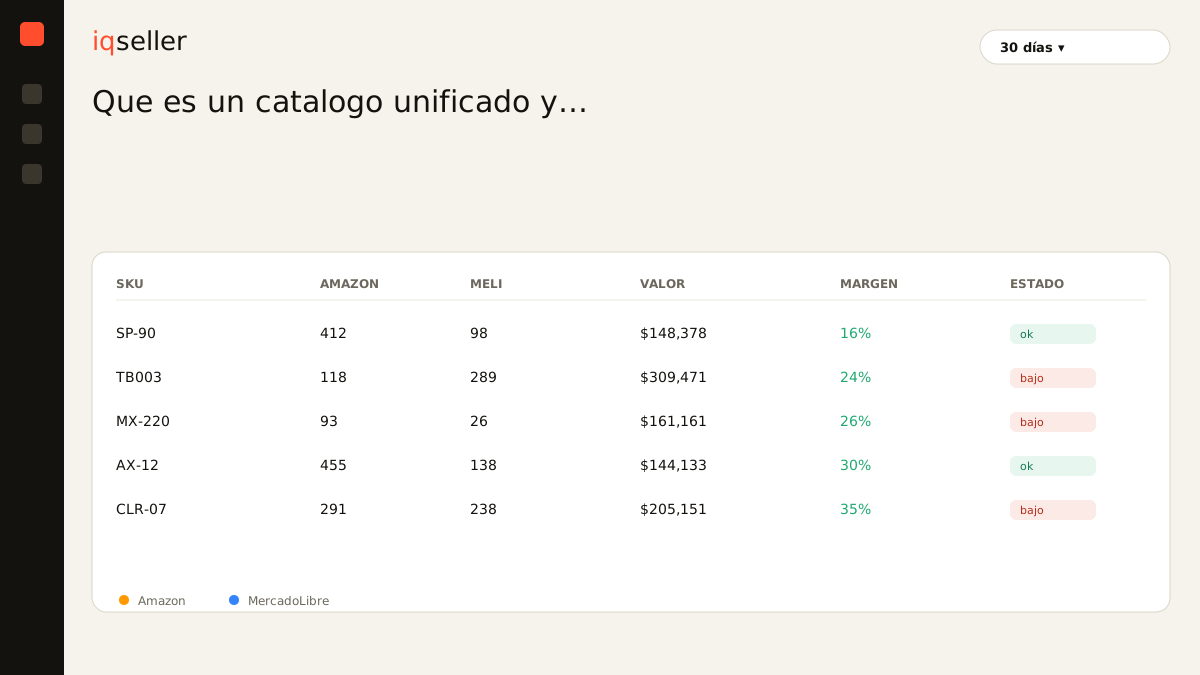
one real product, many listings
The idea that makes it click is to stop thinking in “listings” and start thinking in products. In a fragmented catalog, each listing is its own world: its own stock, its own price, its own description. In a unified catalog, the product is the center and each listing is just a face of that product on a specific channel.
Think of it this way: you have 12 pairs of those sneakers in the warehouse. That “12” is a physical fact, not an opinion. In a unified catalog, that 12 lives on the master product, and Amazon, MercadoLibre and Shopify all read from the same number. When MercadoLibre sells a pair, the master drops to 11 and the other channels know it instantly. There aren’t three inventories to sync; there’s one that gets distributed.
This immediately solves the most expensive multichannel error: overselling. Without unification, each channel believes it has the full 12, so in theory you could sell 36 pairs that don’t exist. With unification, the 12 are 12 for everyone, and when they hit zero, every listing closes together.
the problem of different SKUs
The practical obstacle to unifying is that each marketplace forces you into its own naming. Amazon wants an ASIN and often an EAN/GTIN code; MercadoLibre generates its MLM; Shopify uses its handle; and your 3PL probably has its own warehouse code. None of them speak the other’s language.
Glossary: what an EAN/GTIN is and what it’s for →The solution is a master SKU: your own internal code, unique, that you control, and onto which you hang all the external identities as if they were tags. SNK-BL-42 is the master; the ASIN, the MLM and the handle are attributes of it. That way, when any channel reports a sale, the system translates that external identity to your master and adjusts the right stock. This is exactly the work we detail in master SKU vs channel SKU: how to structure a unified catalog, because structuring that translation layer well is the difference between a catalog that maintains itself and one that breaks at the first change.
why real time changes everything
A unified catalog that updates once a day is barely better than a spreadsheet. The real value shows up when the sync is real time: a sale on one channel adjusts the available quantity on all the others in seconds, not hours.
The delay is where overselling lives. If your inventory syncs every 6 hours and you have 2 units left, in those 6 hours you can sell 2 on Amazon and 2 on MercadoLibre. Four sales, two products. Now you have to cancel orders, absorb platform penalties and explain to two customers why their purchase isn’t coming. That’s the cost of the delay, and you pay it in account reputation.
Glossary: real available, the stock you can actually sell →Real available isn’t just how many pieces exist: it’s how many you can commit after deducting what’s sold but pending fulfillment, what’s reserved and what’s in transit. A well-built unified catalog computes that number once and publishes it to every channel, so none of them promises something another has already sold.
not just stock: price, cost and data
Unifying the catalog also unifies everything else that hangs off the product. The cost lives once, so your margin is calculated the same regardless of channel. The listing content —photos, dimensions, description— gets edited in one place and propagates, instead of you fixing the same typo on four screens.
And pricing stops being chaos. When the product is the center, you can see at a glance what price the same item sells for on each channel, catch that you left an old price on MercadoLibre, and coordinate campaigns with an automatic price calendar that respects each marketplace’s real net margin. Without a unified catalog, you don’t even know the same product is selling at three different prices.
Glossary: unified catalog, full definition →what the day to day looks like
In practice, a unified catalog changes your routine in three concrete ways. First, you create a product once and publish it to the channels you choose, instead of typing the same data four times. Second, when something changes —you raise the cost, it sells out, you update a photo— you change it on the master and it flows everywhere. Third, when something sells, you touch nothing: the system deducts the real available and closes listings when you reach zero.
What disappears is the uncertainty. You no longer open four dashboards to build a mental picture of your inventory. You don’t export three reports into a spreadsheet to cross-check by hand on a Sunday. You don’t sell in fear of overselling. The catalog becomes a single source of truth, and your job shifts from reconciling data to making decisions with that data.
when you really need it
Does everyone need a unified catalog from day one? No. If you sell 5 products on a single channel, a spreadsheet is enough. Unification becomes indispensable when you cross two thresholds: more than one channel and enough volume for manual syncing to start failing. That point arrives sooner than you’d think —usually when you open your second marketplace or connect your first 3PL— because reconciliation work doesn’t grow linearly, it grows multiplied by channels and by SKUs.
If you already live that pain —you sold something you didn’t have, you spend hours cross-checking reports, you don’t trust your own stock numbers— you don’t need convincing on the theory. You’re already paying the cost of not having a unified catalog; you just pay it in cancellations, penalties and your time. Centralizing your products in a master that syncs in real time is, for the multichannel seller, the foundation everything else stands on: pricing, forecasting, margin and the peace of mind of knowing that what you show is what you actually have.