
Reorder Point per Channel: Why One Number Is Not Enough
July 31, 2026
A reorder point is the inventory level at which you need to place a new order so the replenishment arrives before you run out of what you already have selling. The base formula is simple: daily sales velocity multiplied by replenishment lead time, plus a safety stock. The problem is that almost everyone calculates a single reorder point for the whole product, adding up what they sell everywhere, and that global number is exactly the one that leaves you stranded. Amazon and MercadoLibre sell at different paces, with different lead times, from inventories that don’t share instantly, so one reorder point cannot protect both channels at once.
The reason is physical, not a matter of the formula. The units you hold in FBA only serve Amazon demand; the ones in Full only cover MercadoLibre; your 3PL stock feeds self-fulfilled or Flex orders but does not solve an FBA stockout without an internal transfer that takes days. When you calculate “the product sells 30 a day and takes 20 to replenish, so I reorder when I drop below 600,” you’re mixing velocities and compartments that in reality are separate. Six hundred units can be plenty in one channel and not enough in the other at the same time, and because it’s a single number, you never find out.
That’s why a useful reorder point is calculated per channel. Each marketplace has its own recent sales velocity, its own lead time until the unit becomes sellable there, and its own real available stock. You multiply and add the buffer for each one separately, and you end up with several reorder points, one per channel, that trigger independently. It’s more work to set up, but it’s the only version that matches how your inventory actually runs down.
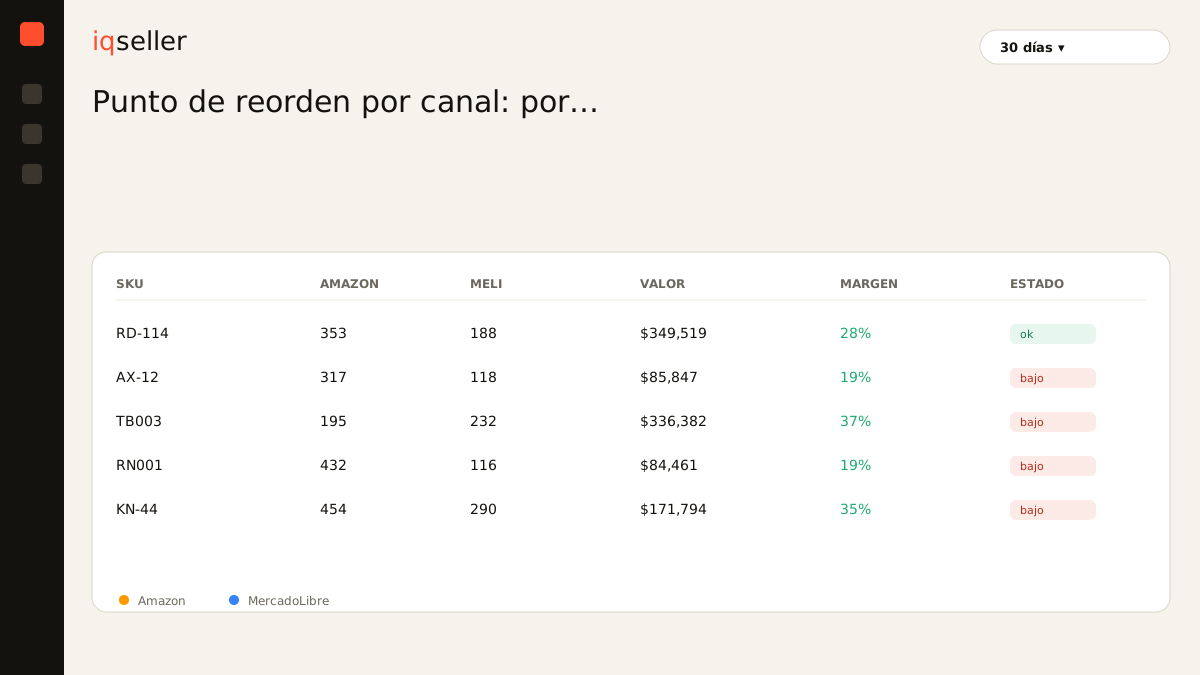
what the reorder point is and where the formula comes from
The reorder point answers a concrete question: with how many units on hand should I place the next order so the replenishment arrives before I hit zero? Wait too long and you stock out; pull the trigger too early and you tie up cash in inventory you didn’t need yet. The reorder point is the balance between those two losses.
The classic formula is reorder point = (daily demand × lead time in days) + safety stock. The first part covers what you’ll sell while the order is in transit; the safety stock absorbs variability, both in demand (a peak week) and in lead time (the supplier runs late, customs gets stuck). If your demand or your delivery times are very irregular, the buffer grows; if they’re stable, it can be modest.
The mistake isn’t in the formula but in the inputs. The moment you decide to use a single daily demand and a single lead time for “the product,” instead of one per channel, is the moment the number stops describing your real operation. The formula is still correct; what’s wrong is feeding it averages that erase the differences that matter most.
why one number lies to you
Take an example. SPORTIFY sells the same knee brace on Amazon and on MercadoLibre. On Amazon it moves 25 a day with a 21-day FBA replenishment; its reorder point is around 525 units plus buffer. On MercadoLibre it sells 6 a day and its Full replenishment takes 10 days; there the reorder point sits near 60 units plus buffer. These are two realities that look nothing alike.
If you average everything into a single global reorder point, you get an in-between number that serves neither. Calculated on total demand (31 a day) and an “average” lead time, it gives you something like 480 units for the whole product. With that single threshold, when total inventory drops below 480 you fire an order, but by then Amazon may have spent days selling below its minimum coverage while MercadoLibre is swimming in stock. The average reassures you with a healthy total and hides the channel that’s already in the red.
The typical result is double waste: you stock out in the fast channel, right where the volume and the money are, and at the same time you carry excess inventory in the slow channel because the global number pushed you to over-order “just in case.” One reorder point cannot optimize two opposite velocities; it always over-protects one and under-protects the other.
lead time also changes per channel
Demand isn’t the only variable that breaks when you average. The lead time that matters for the reorder point is not how long your supplier takes to deliver to you, but how long a unit takes to become sellable in each marketplace. And that number is different per channel even if the supplier is the same.
For FBA it’s not enough to produce and receive: you have to ship to Amazon’s centers, wait for check-in and for the inventory to become available, and that stretch usually adds days or weeks. For Full something similar happens with its own receiving times. A self-fulfilled shipment from your 3PL can be sellable almost immediately. Same product, same supplier, three different real lead times depending on where the unit is headed. We develop this distinction in supplier lead time vs lead time to the marketplace, and it’s the reason a single lead time in the reorder-point formula already dooms you to miss in at least one channel.
When the lead time to each marketplace goes in correctly for each reorder point, you start to see useful things: the channel with the slowest replenishment needs to fire its order much earlier, even if its sales velocity is lower, precisely because transit time dominates the equation. One number flattens that difference and makes you order late exactly where you take longest to restock.
Glossary: days of inventory measure how long your stock will last at the current sales pace; converting the reorder point into days of coverage per channel is what lets you compare two marketplaces that sell at different speeds.calculate it on real available stock, not the report figure
Even with the right demand and lead time per channel, there’s a third point where the calculation fails silently: the inventory level you compare the reorder point against. If you compare against the warehouse’s physical stock, the big number on the report, your reorder point triggers late by definition, even if it looks conservative.
The honest level is always the real available stock per channel: what can genuinely be sold today, once you subtract reservations for in-process orders, units under inspection, returns being restocked, and inventory blocked by some listing problem. That number is usually quite a bit lower than the report’s. If your reorder point watches real available stock, a channel can enter reorder territory even while the warehouse still shows plenty of units, and that’s exactly the case you need to see in time to avoid stocking out.
Glossary: real available stock is what you can sell right now, once reservations, returns being processed, and blocked inventory are subtracted; it’s the only honest basis to compare against a reorder point.why this becomes impossible by hand
A reorder point per channel holds up once, for one SKU, in a good spreadsheet. With dozens or hundreds of products across three or four channels, the math breaks on the second day. Each reorder point depends on three variables that change all the time: recent sales velocity, current lead time, and real available stock. Multiply that by every SKU and every channel and you have hundreds of numbers that should be recalculated daily.
You know the pattern: you open Seller Central to check sales and FBA, then MercadoLibre for Full and Flex, then the 3PL sheet that arrived by email on Monday, you paste it all into one sheet, divide each channel’s demand by the days, multiply by the lead time you remember from memory, and by the time you finish the data is already from yesterday. The buying decision, which moves real money, you make with that uncertainty on top and the suspicion that somewhere in a row you got it wrong.
That’s where real time stops being a luxury and becomes the only sustainable path. Instead of you gathering the information, the system reads the real available stock of each channel, cross-references it with the current sales velocity and the lead time to each marketplace, calculates each channel’s reorder point separately, and alerts you when any of them is crossed. You no longer scan tabs at eleven at night to discover a stockout; you see the order coming with days of margin. That alert is also worth cross-referencing with your automatic price calendar, so an urgent restock with express freight doesn’t ruin the price you had already planned.
Glossary: a stockout is when you run out of sellable units in a channel; the per-channel reorder point exists precisely so that stockout never catches you by surprise where your volume is.how to set up your reorder points properly
Start by separating the velocities. For each important SKU, take the recent daily demand of each channel separately, not the sum. Decide which window you use to calculate it: the 7-day window captures seasonal accelerations, the 30-day one smooths out the noise. A product at its seasonal peak is better served with the short window so you don’t underestimate demand; one just out of a promotion is better read with the long window so you don’t mistake a passing spike for the new normal.
Continue with the real lead time of each channel, from order to sellable unit in that marketplace, including the FBA or Full receiving stretch, not just what the supplier takes. Add a safety stock proportional to how irregular that channel’s demand or delivery time is: if a channel is stable, a modest buffer; if it’s volatile, a larger one. With those three ingredients per channel, you calculate a reorder point per channel and let each one trigger when it should.
Close by reviewing the action before you buy. Sometimes a channel’s reorder point is crossed not because product is missing overall, but because you have plenty in another channel; in that case the right answer is to reallocate, not to buy. Other times you do need to order, and then it’s worth checking that the margin can absorb the freight it will take. That balance between not arriving late and not buying badly is what separates an operation that restocks with a plan from one that fights fires with eaten margin every month.