
Real Available Stock: How to Know What You Can Truly Sell Right Now
July 21, 2026
Real available stock is the number of units you can actually sell right now: your total stock minus everything already committed, in transit, or blocked. The short formula is simple: real available stock = physical stock − reserves − unreceived transit units − holds (damaged, under review, or retained by the platform). If you have 100 units in the warehouse but 30 are already earmarked for paid orders, 10 are en route and not yet arrived, and 5 are damaged, your real available stock is not 100: it is 55. That number, not the gross count, is what you should be publishing on every listing.
This matters because a multichannel seller does not sell against a warehouse; they sell against several marketplaces at once. Amazon Mexico, MercadoLibre, your Shopify store, and even a 3PL all share (or should share) the same pool of units. When each channel shows its own count without deducting what the others have already sold or reserved, you end up promising units that no longer exist. The result is overselling, cancellations, platform penalties, and a reputation that takes months to rebuild.
In this article you will see exactly what gets subtracted to reach real available stock, why the gross count deceives you, how the calculation breaks when you juggle several channels by hand, and what changes when that number is computed in real time instead of in a spreadsheet you refresh every night.
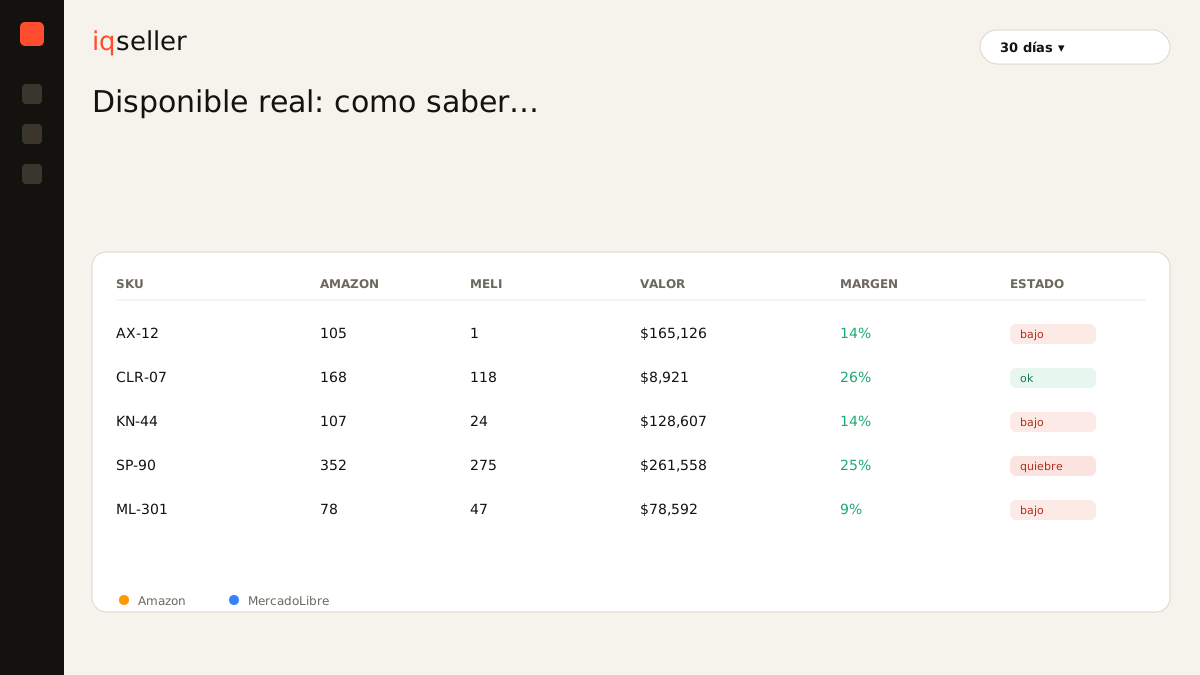
what gets subtracted to reach real available stock
The total stock your warehouse system shows is a starting point, not an answer. To turn it into real available stock you have to subtract four groups of units that physically exist but that you cannot promise:
- Reserves. Units already assigned to paid orders that have not yet left the warehouse. They are there, you can touch them, but they have an owner. Counting them as sellable is the most common mistake.
- Unreceived transit. Inventory you bought and that is on its way, but that has not arrived or been validated yet. Many sellers add it “in advance” to avoid looking short, and that is where overselling is born.
- Internal holds. Damaged product, quality quarantine, or units set aside for warranty replacements. Physically present, commercially not.
- Platform retentions. In FBA, for example, there are units in “reserved,” “under investigation,” or “inbound” states that Amazon will not let you sell even though they appear in your inventory.
The mental rule is simple: if you cannot ship it today without breaking another promise, it is not real available stock. Everything else is optimistic accounting.
why gross stock deceives you
The gross number lies by omission. It is not miscalculated; it answers a different question. Gross answers “how many units do I have?”, and you need to answer “how many can I sell right now without letting someone down?”. Those are different things, and the distance between them is exactly the risk you are carrying.
Picture a seller running the same SKU across three channels. Their warehouse says 40 units. Amazon shows all 40, MercadoLibre shows 40, and Shopify shows 40. On paper they have 120 units for sale when in reality they have 40. All it takes is parallel orders on a Friday afternoon for them to sell 60 and only be able to fulfill 40. The other 20 turn into cancellations, refunds, and, on strict marketplaces, direct hits to their account health metric.
Gross also hides the moment of the stockout. Because it does not deduct reserves or transit, it makes you believe you have a cushion when you are already on the edge. By the time you finally see zero, you have already oversold. Real available stock, on the other hand, warns you earlier: it drops to critical levels while there is still time to pause the listing or restock.
the multichannel seller’s pain: piecing it together by hand
Here is the root problem, the one lived every day by anyone who sells in several places. The information for real available stock exists, but it is broken into pieces. Physical stock lives in the warehouse system or the 3PL. Reserves live inside each marketplace. Transit lives in a supplier email or another sheet. Quality holds live in the head of whoever receives the goods.
To assemble the number, the seller opens five tabs: Amazon Seller Central, the MercadoLibre panel, the Shopify admin, the 3PL portal, and their master Excel. They copy, paste, subtract by hand, and by the time they finish, the number has already changed because orders came in while they worked. It is a calculation that is born stale. And because it hurts to do, it gets done once a day at best, or once a week at worst.
That lag is where overselling lives. Not because the seller is careless, but because calculating real available stock by hand in real time is humanly impossible when you have dozens or hundreds of SKUs spread across four channels that move every minute. The spreadsheet is yesterday’s map for today’s decisions.
real available stock in real time: the single pool
The solution is not to calculate faster by hand; it is to stop calculating by hand. When a single system connects warehouse, 3PL, and every marketplace, real available stock stops being a number you assemble and becomes a number you look up. There is one pool of units and every channel draws from it. If MercadoLibre sells one, availability drops for Amazon and Shopify at the same instant, without anyone copying or pasting anything.
In iqseller real available stock is recomputed with every movement: each sale, each reserve, each transit receipt, each quality hold adjusts the number on the spot. That way the listing never offers units another channel has already committed. The seller stops living with the doubt of “is what I see really what I have?” because the number they see already has everything unsellable subtracted out.
That changes concrete decisions. You can trigger restock rules when real available stock (not gross) crosses a threshold. You can automatically pause a listing before it hits zero. And you can promise delivery dates with the confidence that the units truly exist, not just in theory.
real available stock, days of inventory, and coverage
Real available stock does not live alone; it is the foundation of nearly every inventory metric worth having. If you calculate your days of inventory on gross stock, you get an inflated number that makes you feel calm when you should be buying. Correct days of inventory start from real available stock: how many days the units you can truly sell will last at your current sales pace.
The same goes for stock coverage. If you care about the fine distinction between the two concepts, we develop it in days of inventory vs stock coverage: what sets them apart, but the key idea for this topic is that neither is useful if you feed it a stock figure that never deducted reserves or transit. Garbage in, garbage out.
And on the profitability side, real available stock touches your advertising too. There is no point pushing paid traffic to a listing that is about to run out: you burn budget on clicks that will end in “unavailable.” That is why it pays to cross your sellable inventory against your ad spend; if you have not mastered that metric yet, start with what is ACoS and then come back to read your real available stock as a traffic light for pausing or sustaining campaigns.
how to start measuring your real available stock today
You do not need everything automated to take the first step. Start by listing, for your most important SKUs, the four deductions: reserves, transit, holds, and platform retentions. Just doing that exercise once will reveal SKUs you thought were healthy that are actually on the edge of a stockout.
The second step is to stop publishing the same number across every channel without coordinating them. Even with manual rules, split your real available stock across marketplaces or, better, point them all at the same pool. The third step, the one that truly removes the pain, is to connect your channels to a system that computes real available stock in real time for you, so that the question “how much can I sell right now?” has a reliable answer at any hour, without opening five tabs or touching the Excel.
Truly selling what you have, rather than what you think you have, is what separates a multichannel operation that grows from one that spends the month putting out oversell fires.