
Per-Channel Pricing: Why One Product Needs Different Prices
July 24, 2026
Per-channel pricing is the practice of setting a different price for the same product on each marketplace where you sell it —Amazon, MercadoLibre, your Shopify store— because every channel charges you different commissions, fees, and costs. It’s not a gimmick or a way to confuse the buyer: it’s the only way to make the same SKU leave you the same net margin everywhere. If you put the same number in every channel, you’re giving away profit on the expensive channel and leaving money on the table on the cheap one.
The confusion comes from a reasonable but wrong idea: “it’s the same product, it should cost the same.” The buyer sees the product; you see the product minus the channel’s commission, minus the fulfillment fee, minus shipping, minus advertising. That “minus” is different on every channel, and it can vary fifteen or twenty percentage points from one to another. A single price does not mean a single margin; it means uncontrolled margins you aren’t even looking at.
This article explains why one product needs different prices, how to calculate each channel’s price starting from the margin you want to protect —not the price you’d like to charge— and why doing it by hand in Excel, with four dashboards open, is exactly where the multichannel seller loses control. The logic is simple; the problem is execution when every channel pulls in its own direction.
why the same product doesn’t cost the same to deliver
Let’s start with what the buyer never sees. When you sell a speaker for $899 on Amazon with FBA, those $899 don’t reach your pocket. Amazon keeps a referral fee (typically between 8% and 15% depending on category), plus the FBA fee for storing and shipping the unit, plus —if you advertise— whatever you spent on ACoS to make that sale happen. What’s left after all that is your real margin, and it’s usually a good deal less than the list price suggests.
Now sell the same speaker for $899 on MercadoLibre. Meli’s commission is different, the MercadoEnvíos cost is different, the free-shipping-above-a-threshold rules are different, and Product Ads behave differently. The same $899 price leaves you a different net margin on each channel —sometimes by several points. And on your Shopify store, where you only pay the payment gateway and the shipping you negotiate with your 3PL, that same $899 probably leaves you the highest margin of the three.
That’s why per-channel pricing isn’t optional for anyone selling seriously in multiple places. The right price on each channel is the one that, after subtracting its commissions, its fees, and its logistics cost, returns the target margin you defined. Charging the same everywhere is like charging without looking at the receipt: the number looks tidy, but underneath, every channel is leaving you something different.
Glossary: what real net margin is and why it’s the number that truly rules per-channel pricing →start from the margin, not from the price
The classic mistake is to set the price first and discover the margin afterward. It works the other way around. First you decide how much net margin you want to protect on that product —say 22%— and from there you walk backward on each channel to the list price that produces it.
In practice: you take the product cost, add the target margin, and to that subtotal you add, channel by channel, what that channel is going to deduct. On Amazon you add the referral fee, the FBA fee, and your ACoS budget. On MercadoLibre you add Meli’s commission and the shipping cost you absorb. On Shopify you add the gateway and your shipping. The result is three different list prices that all land on the same 22% net margin. That’s the goal of per-channel pricing: same margin, different prices.
This reasoning is exactly what connects to what is ACoS. ACoS is not a separate expense you review at the end of the month; it’s a per-channel cost component that has to enter the price before you set it. If your speaker needs 12% ACoS to sell on Amazon, that 12% is part of the cost of selling it there, and Amazon’s price must carry it. When ACoS lives in one report and price in another dashboard, that sum never happens, and you discover the following month that you sold at a negative margin without knowing it.
price is not a snapshot: it changes while you look away
Even if you calculate the three perfect prices today, tomorrow they aren’t perfect anymore. Amazon adjusts FBA fees, MercadoLibre changes its commission rules by season, your 3PL cost goes up, a competitor drops their price and forces you to move, or you yourself launch a promo on one channel and forget to reflect it on the others. Per-channel pricing isn’t a calculation you do once; it’s a balance that goes out of tune constantly.
This is where the manual flow breaks. The typical multichannel seller has Seller Central open in one tab, the MercadoLibre panel in another, the 3PL’s in a third, and an Excel sheet where they pull everything together by hand to “see the margins.” By the time they finish copying the numbers, those numbers are already a while old. They decide with yesterday’s data, on prices that changed today. And with fifty SKUs across three channels, they can’t even review them all: most run without anyone watching their real margin until something goes off the rails.
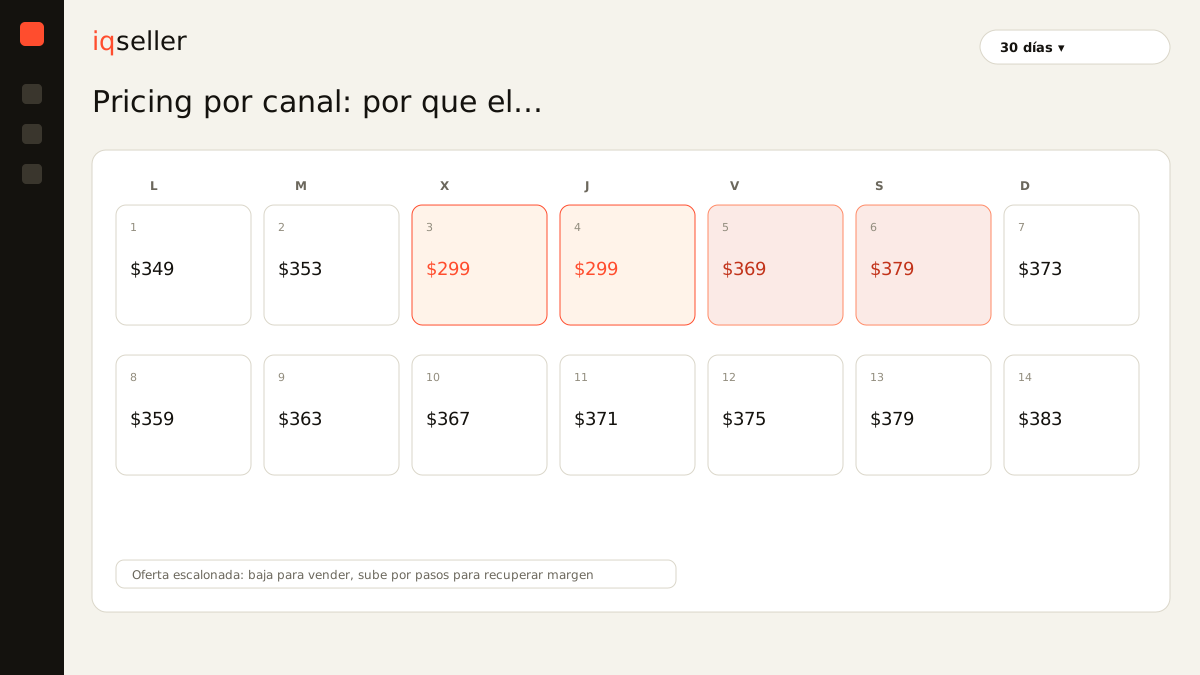
An organized price calendar solves a good part of this: it lets you schedule the per-channel changes in advance —the Amazon promo that starts Friday and ends by itself on Monday, the MercadoLibre price bump after a big sale event— instead of changing them by hand and praying you remember to revert them. A scheduled change isn’t forgotten; a manual one is.
Glossary: what a price calendar is and how it keeps a forgotten promo from eating your margin →price, Buy Box, and the temptation to match the competitor
On Amazon, price doesn’t just define your margin: it defines whether you win or lose the Buy Box, the buy box that concentrates the overwhelming majority of sales. Dropping the price can help you win it, but every peso you drop comes straight out of your margin. The right question is never a bare “how do I win the Buy Box?” but “what’s the lowest price I can set on this channel without breaking my target margin?”.
We develop that relationship between what you charge and what you earn in depth in Buy Box and price: how what you charge affects winning it. The key idea for per-channel pricing is that Amazon’s price carries a pressure Shopify’s doesn’t: the competition for the box. That’s why sometimes the margin you accept on Amazon is tighter than on your other channels —and that’s fine, as long as it’s a conscious decision and not an accident of putting the same number everywhere.
The most expensive temptation is to match a competitor’s offer without recalculating the margin. You see someone drop and you drop too, by reflex. But matching without looking at your per-channel costs is how you start a price war that burns your profit faster than the competitor’s —exactly the scenario worth avoiding. You lower a price with the margin calculator in hand, not by reflex.
not always lower: tiered offers and volume
Per-channel pricing isn’t only about defending a fixed margin. Sometimes the right play is to accept a lower margin per unit in exchange for more volume —but in a controlled way, not by giving it away. That’s where the tiered offer comes in: discounts that trigger by quantity or by threshold, different on each channel depending on how people buy there.
On MercadoLibre, where free shipping above a certain amount nudges the buyer to add products, a well-placed tiered offer raises your average ticket without touching the base unit price. On Amazon, a volume discount can make sense to move inventory that’s approaching long-term storage fees. Each channel rewards a different kind of offer, and per-channel pricing includes deciding which promotion goes on which channel —not just what base price.
The important thing is that every tier still respects a margin floor. A tiered offer with no floor is a price war against yourself: you sell more, but each extra unit leaves you less, and at some tier you cross into a loss without noticing. The tier is designed from the minimum acceptable margin upward, just like the base price.
Glossary: what a tiered offer is and how to use it per channel without crossing into a loss →from four dashboards to one source of truth
Per-channel pricing, done right, requires seeing three things together for each SKU and each channel: the list price, all the discounts and fees that channel applies, and the net margin left at the end. That calculation, done by hand across four screens, is slow, done late, and error-prone. That’s why so many sellers end up operating blind: not because they don’t know the formula, but because gathering the data to apply it is work there’s no time to do well.
When prices, commissions, fees, and costs across all channels live in one place and update on their own, the net margin per channel stops being a calculation you chase and becomes a number that’s already there, ready to read. You see at a glance that your speaker leaves you 22% on Shopify, 18% on Amazon, and 15% on MercadoLibre, and you decide with that complete picture —not with three old numbers you copied at different moments.
For anyone selling the same catalog on Amazon, MercadoLibre, Shopify, and a 3PL at once, per-channel pricing stops being a spreadsheet you’re afraid to open and becomes what it always should have been: an informed decision, channel by channel, with the margin in plain sight. It’s not a slogan; it’s simply what happens when one source of truth does the sum you used to do by hand —late, and afraid of getting it wrong.