
Buy Box and Price: How What You Charge Affects Winning It
July 29, 2026
The most direct question a seller asks when the “Buy Now” button lands on someone else’s offer is simple: does charging less actually win the Buy Box? The short answer is no. Price matters —a lot— but it enters the equation as the landed price, meaning product plus shipping, and it competes against delivery speed, account health, and stock availability. What you charge influences the outcome, yes, but it is almost never the only thing that decides it, and cutting your label usually costs more margin than it recovers.
Put plainly, so it is clear from the first paragraph: in Amazon’s Buy Box, your price competes against yourself as much as against your rival. Every dollar you cut comes straight out of your profit, not out of some abstract cushion, and the algorithm weighs that cut alongside other signals that often matter more. Understanding how price sits inside that mix is what lets you win the box without giving away profitability.
The underlying pain is familiar to any multichannel seller: Amazon Seller Central in one tab, MercadoLibre in another, the 3PL dashboard in a third, and a hand-updated spreadsheet that is already stale by mid-morning. With that setup, the decision to match a competitor is made on yesterday’s data, with no idea how much real margin is left after fees and shipping. This article explains exactly how what you charge affects winning the box, and why seeing it in real time changes the call.
what the landed price really is
When Amazon compares offers to assign the Buy Box, it does not look at the label you see on the listing: it looks at the landed price, which adds the product price plus the shipping the buyer pays. This has a big practical consequence. A competitor on FBA with free shipping can charge the same as you on the product and still present a lower landed price, because their shipping adds nothing to the total the algorithm sees.
So the question “am I charging more or less than my competitor?” is framed wrong. The right question is “is my landed price competitive?” Sometimes the gap is not in the product but in the logistics: you ship on your own with a cost the buyer pays separately, and that difference knocks you out of the box even when your label is identical. Migrating that SKU to FBA or MercadoLibre Full can win the Buy Box without touching the price at all.
how much price weighs against the other signals
The Buy Box algorithm is not an auction for the cheapest offer. It weighs landed price alongside the shipping method, the promised delivery speed, the seller’s account health, service metrics, and inventory availability. Price is one of the strongest signals, but not the only one, and its relative weight shifts with the category and the competition on the listing.
That means two sellers with identical prices can get different results: the box goes to whoever delivers faster, has a better defect rate, or keeps steadier stock. And the reverse: a competitor sometimes wins the Buy Box without being the cheapest, simply because their account is healthier. When you lose the box, then, the first move is not to drop your price: it is to diagnose which signal failed you. If you cut the label to fix a delivery-speed problem, you gave away margin without solving anything.
Glossary: real net margin, with commission, fees, and shipping deducted →why cutting price hurts more than it looks
Here is the math almost nobody runs before matching a competitor. Say you sell at $500 with a 20% real net margin, meaning $100 of profit per unit. If you drop the price 10% to recover the Buy Box, you do not lose 10% of your profit: you lose $50 of those $100, half. Margin does not move in proportion to price, it moves against what was left after commission, logistics fee, storage, returns, and advertising.
And it is rarely a single cut. Your competitor matches, you drop again, and within two or three rounds you both sell at a price that no longer leaves profit —while still paying commission and FBA fees on every sale—. That is why price, even though it influences winning the box, is the most expensive lever: every move comes straight out of net profit, not out of a cushion you can trim without feeling it.
The takeaway is not “never lower your price,” but “lower it with a criterion”: knowing your real floor per channel and how far you can give without going into the red. Without that floor, matching is a blind bet.
your price floor is calculated per channel
The costliest trap is believing you have one minimum price. You do not: you have one per channel, because Amazon, MercadoLibre, and 3PL costs are different. A price that leaves 18% margin on Amazon FBA may leave 9% on MercadoLibre Full, or the reverse, depending on the category, the product weight, and each platform’s shipping rate.
If you fight the Buy Box on Amazon while looking at the margin you calculated for MercadoLibre, you are deciding with the wrong number. The floor has to start from real net margin —everything deducted— and be specific to that channel. As we cover in real-time inventory, the competition’s price and your own stock move throughout the day, and every move pushes your effective margin even when you touch nothing. Seeing that effect per channel, in the moment, is what separates an informed answer from a panic reflex.
the levers that are not price
Before touching price, there is a repertoire of moves that recover the box without sacrificing a single point of margin:
- Logistics. Migrating a SKU to FBA or MercadoLibre Full improves the promised delivery time and lowers the landed price when shipping stops adding to the total. Sometimes the competitor beats you on speed, not on price.
- Availability. The algorithm punishes low or irregular stock. Keeping healthy inventory often weighs more than a dollar off the label.
- Account health. Defect rate, cancellations, and late deliveries affect your Buy Box eligibility. Cleaning that up is free in margin terms.
- Included shipping, with a criterion. Since Amazon looks at the landed price, absorbing shipping on a low-logistics-cost product can leave you more competitive than a direct price cut.
Each lever attacks a different reason you lost the featured offer. Diagnosing before acting is worth more than any “always match the cheapest” rule.
when a lower price does make sense (and when to let go)
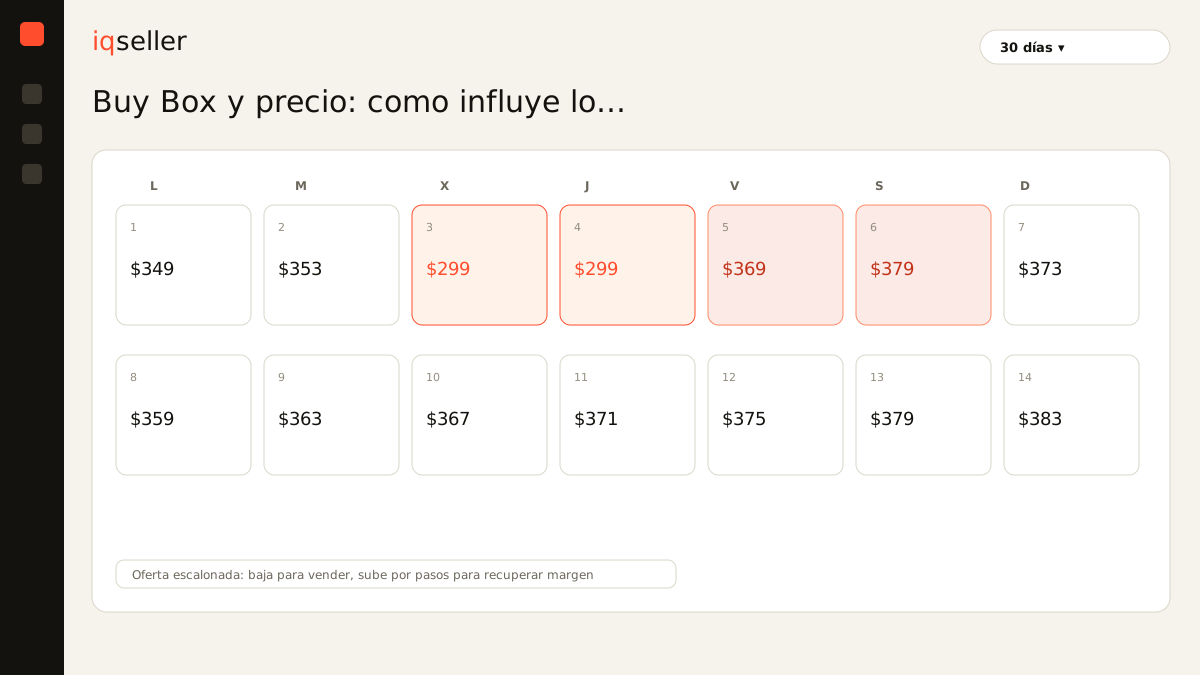
There are moments when adjusting price is the right play: a launch where you want early volume, a seasonal spike where you want to capture the box while demand lasts, or a SKU with a cost so good you still compete cheaply without leaving your floor. The key is that it be a planned decision, not a reflex. Scheduling those moves with a tiered offer —drop to sell, step back up to recover margin— turns price into a tool instead of a leak.
And sometimes the profitable decision is not to fight. If defending a product’s Buy Box forces you to sell below your floor, that product is better off without the featured offer: you lose volume, but you stop subsidizing loss-making sales. The right question is not “how do I recover the box?” but “how much does recovering it cost me, and what do I get in return?” That is only decided well when you see, in one view, what to defend and what to release based on real profitability. A price calendar lets you define in advance how far to give, on which products, and for how many days.
a single source of truth to decide
The common thread is that the Buy Box is not won with reflexes, it is won with information. And the multichannel seller’s information lives scattered: the competition’s price on Amazon, yours on MercadoLibre, inventory at the 3PL, each channel’s fees. As long as those pieces live in separate tabs and a hand-updated spreadsheet, you will decide late and on stale data —exactly the conditions that trigger a price war—.
The alternative is having it all together, in real time: price per channel, your margin floor per channel, Buy Box status, and inventory in one panel. Setting a healthy margin in advance helps you know how far to give without hesitating; we go deeper on that in what net margin is healthy for an Amazon and MercadoLibre seller. That is how a store like SPORTIFY defends its star SKUs without a competitor dragging it into selling at a loss.
In iqseller the goal is simple: to turn “price influences winning the box” from a vague phrase into a number you see in the moment. How much real margin is at stake, what your floor is per channel, and which lever —price or another— returns the Buy Box at the lowest cost. That is the difference between defending your profitability and giving it away a dollar at a time.