
How to Calculate the Real Profitability of a Marketplace Product
August 1, 2026
The real profitability of a marketplace product is what you keep after subtracting, from the sale price, every cost that eats into that revenue: the product cost, the marketplace commission, the fulfillment fees (FBA or Full), shipping, returns, advertising and tax. That final number, expressed as a percentage, is your net margin — the one figure that tells you whether a SKU actually makes you money or just moves inventory.
The most common mistake a multichannel seller makes is confusing two things: gross margin (price minus product cost) and real net margin. Between the two sits a long line of deductions that Amazon and MercadoLibre apply at different points, many of them variable by category, weight, season and channel. When you sell the same product across several platforms, that line changes on each one, and a SKU that is profitable on Amazon can be losing money on MercadoLibre without you noticing.
In this article you get the full formula, component by component, with a worked numeric example so you can apply it today to any of your products. The goal is to stop estimating “roughly” and start reading your profitability with the same rigor Amazon uses to charge you each fee.
what each marketplace deducts before you see your money
Before building the formula it helps to be clear on the order of the deductions, because they do not all come from the same place or at the same time. On Amazon Mexico, on top of the tax-inclusive sale price, they apply in sequence:
- Referral fee: a percentage of the sale price, different by category, typically between 8% and 20%.
- FBA fee (fulfillment): a fixed amount per unit based on weight and dimensions, if you use Amazon’s logistics.
- Storage: a monthly rent for the space your inventory occupies, plus a long-term charge if it turns over slowly.
- Inbound: the cost of shipping your goods to the fulfillment center. Almost nobody prorates it per unit, and on cheap products it is decisive.
- Returns and refunds: not an exception but a statistical cost you must provision for.
- Advertising: if you run Amazon Ads, the spend comes straight out of your margin. This is where your ACoS acts as a spending ceiling.
- Tax (IVA): the tax you collect and remit; if you treat it as revenue, you inflate your margin artificially.
On MercadoLibre the structure is similar but not identical: the commission varies by listing type (classic or premium), the shipping cost depends on your reputation and the Full program, and there is a fixed per-unit charge on low-price items. That is why the same product cost produces two different margins depending on the channel.
the real net margin formula
With all the components gathered, the formula to reach a product’s net margin is this:
Net margin = Sale price − Product cost − Marketplace commission − Fulfillment fee (FBA/Full) − Prorated storage − Inbound per unit − Returns provision − Ad spend − Applicable tax
The real net margin is that figure divided by the sale price, expressed as a percentage. The key lies in two details almost everyone skips: prorating the fixed costs (storage and inbound) across the units you actually sell in the period, and treating tax as what it is — a levy you collect, not your own profit.
When you do this per SKU and per channel, you uncover uncomfortable truths: “star” products by volume that actually leave 3%, and quiet products that leave 30%. Without net margin per product, your sales mix is optimized to invoice, not to earn.
a worked numeric example
Take a product you sell on Amazon FBA at $499 tax included. Its cost is $180. Let’s subtract step by step:
| Item | Amount |
|---|---|
| Sale price (tax incl.) | $499 |
| Tax to remit (16%) | −$69 |
| Product cost | −$180 |
| Referral commission (~15% of price) | −$75 |
| FBA fee | −$70 |
| Storage + prorated inbound | −$25 |
| Returns provision (~4%) | −$20 |
| Margin before Ads | $60 (12%) |
That 12% is already far from the “almost 64%” the gross margin suggested ($499 − $180). And advertising is still missing: if you run Amazon Ads at a 10% ACoS ($50 on the price), your real margin drops to $10, a 2%. That SKU stays alive only as long as you don’t add a single peso to the campaign.
The same product listed on MercadoLibre with a premium listing (higher commission) and reputation-subsidized shipping can give you a different margin, better or worse. That is why the calculation is not done once: it is done per channel and revisited whenever the fees change.
why the spreadsheet is always behind
Here is the real pain of the multichannel seller. These numbers are not static: FBA fees get updated, storage rises in peak season, your return rate shifts, and the commission can vary by category. Keeping a spreadsheet with hundreds of SKUs, hand-crossing Amazon’s reports, MercadoLibre’s, and your 3PL’s, is a job that never ends and always reflects last month.
The problem is not just the effort: it is that you decide on stale data. You raise the price on one channel without seeing that on the other that SKU was already at a loss. You pour Ads budget into a product whose margin can’t take it. You compare “sales” across platforms without normalizing commissions or tax, and the conclusions come out crooked. To tell when one fulfillment method beats another, see FBA vs FBM: how fees and your margin change per product, because the same SKU changes margin depending on who ships it.
what seeing it in real time solves
Useful profitability is the one you see today, per product and per channel, with everything already subtracted. When net margin is calculated in real time and updates on its own, you stop chasing data and start making decisions on the figure that matters.
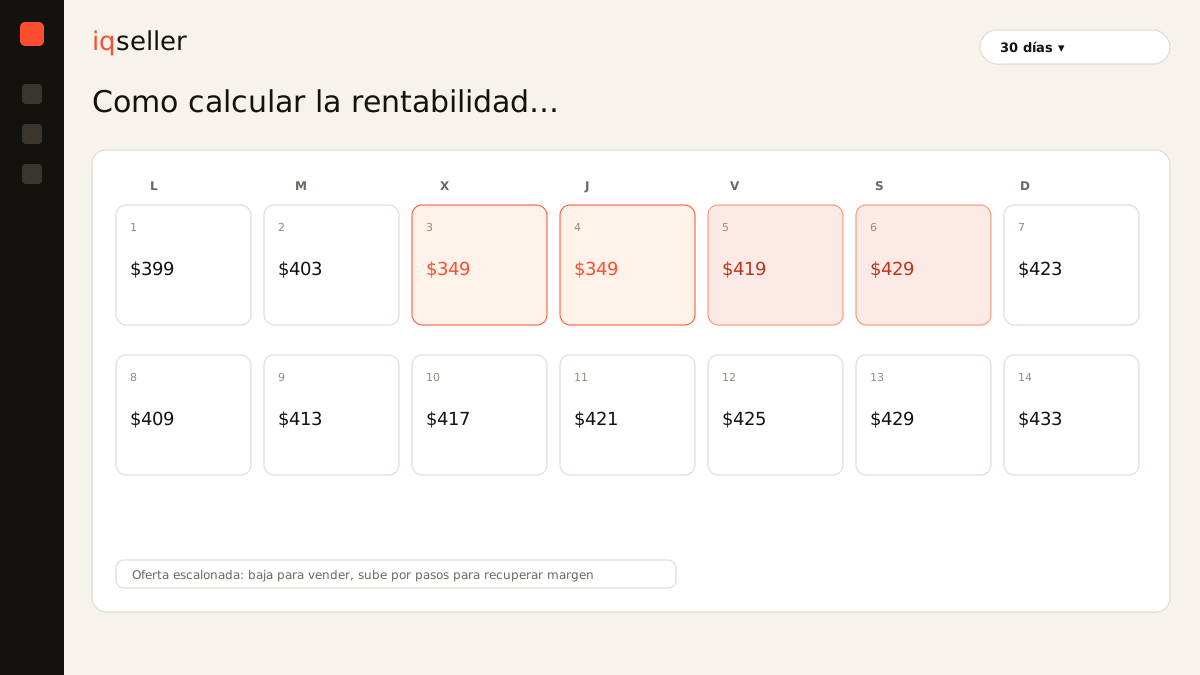
With that foundation you can do things that are impossible by hand: schedule price changes with a price calendar that respects a margin floor, or build a tiered offer that lowers the price by volume without crossing into a loss. In both cases the lever is the same: knowing the real net margin per unit before moving anything.
iqseller brings together data from Amazon, MercadoLibre, Shopify and your 3PL in a single view and calculates the real net margin per product and per channel, subtracting commissions, fees, shipping, returns and tax automatically. The idea is not to give you yet another dashboard, but to let you stop building the calculation by hand and see, for each SKU, whether it is truly leaving you money.
in summary
The real profitability of a product is not “price minus cost”: it is what remains after commission, fulfillment, storage, inbound, returns, advertising and tax, calculated per channel. That is your net margin, and it is the only figure that tells you which SKU to sustain, which one to reprice, and which one to stop pushing. Calculating it by hand once helps you understand the mechanics; seeing it in real time is what lets you grow without growing at a loss.
Want to see your real net margin per SKU and per channel? Join the beta waitlist.