
Minimum Profitable Price: How to Calculate Your Selling Floor
July 22, 2026
Your minimum profitable price is the exact number below which every sale loses you money. You calculate it by adding up everything it costs to put that product in a buyer’s hands —product cost, marketplace commission, FBA or Full fees, shipping, tax, and your prorated fixed costs— then adding the minimum margin you’re willing to accept. That total is your selling floor: the point where your profit is zero (or the minimum you defined). Selling a cent below it isn’t “selling cheap,” it’s paying to give product away.
The short formula is direct: minimum profitable price = (product cost + variable costs per unit + prorated fixed costs) ÷ (1 − % of commissions and fees − % of minimum margin). The arithmetic is the easy part. The part that breaks multichannel sellers is pulling the numbers together: each channel charges differently, fees change, tax slips in, and almost nobody has a trustworthy figure for what a unit actually costs them today.
This article takes that floor apart piece by piece and shows you why the same SKU has a different minimum profitable price on Amazon than on MercadoLibre —and why calculating it by hand in a spreadsheet almost always gives you a stale number.
what the selling floor actually is
Your selling floor is not your purchase cost. That’s the most expensive mistake a new seller makes: “it cost me $180, if I sell it for $220 I make $40.” No. Between that $220 and your pocket there’s a line of hands taking a cut: the marketplace takes its commission, the fulfillment platform its fee by weight and size, the tax authority its tax, and your operation its fixed costs (warehouse, software, salaries, packaging).
The minimum profitable price is the number that already has all of that deducted and still leaves you the margin you decided was minimally acceptable. If your minimum margin is 0%, it’s your pure break-even point: you neither gain nor lose. Most sellers don’t set their floor at break-even; they add a cushion —10%, 15%, whatever their category can bear— so a return or a fee adjustment doesn’t push them into the red.
the components almost everyone forgets
A well-built selling floor adds up more things than it seems. The usual suspects:
- Product cost. What you pay per unit, with import freight, customs and handling prorated in. Not the naked invoice price.
- Marketplace commission. Amazon and MercadoLibre charge a percentage on the sale price, and that percentage changes by category. It’s a cost that grows when you raise the price, not a fixed amount.
- Fulfillment fees. FBA charges by handling and size; MercadoLibre Full charges its own fee. They depend on weight and dimensions, not on price.
- Tax. The tax you pass through and the creditable tax on your costs change the real net number. Ignoring it inflates your apparent margin.
- Prorated fixed costs. Warehouse, software, salaries, packaging, the portion of your ad spend you can’t attribute to a specific sale. Spread across the units you move.
- Returns and shrinkage. A percentage of your sales gets returned or damaged. If your floor doesn’t account for it, your real margin is lower than you think.
why the minimum profitable price changes per channel
Here’s the trap that makes a single “one number for all channels” useless. Your product cost is the same on Amazon and on MercadoLibre, yes. But everything else changes: the commission by category differs, FBA fees aren’t Full’s fees, and free-shipping promotions get absorbed by one channel or the other depending on your terms.
The result is that the same SKU can have a floor of $312 on one channel and $349 on the other. If you publish the same “flat” price on both, you’re either leaving margin on the table on the cheap channel, or selling below your floor on the expensive one without noticing. That’s why the minimum profitable price is calculated per channel, and it’s the foundation on which you later build your per-channel pricing strategy.
the problem with calculating it by hand
In theory, a spreadsheet solves this. In practice, the multichannel seller lives a familiar pain: they open the Amazon fees report in one tab, the MercadoLibre one in another, their cost file in a third, and try to reconcile three sources that speak different languages and refresh at different moments.
That spreadsheet is born stale. The day Amazon adjusts an FBA fee, your floor is out of date and you don’t find out until the month’s margin doesn’t close. When you switch suppliers and the unit cost rises, you have to go SKU by SKU recalculating by hand. And when you manage hundreds of products, nobody keeps that file current: it becomes a blurry photo of how things stood three weeks ago.
The cost of that stale photo isn’t theoretical. It’s launching a promo you thought was profitable that was actually selling below the floor. It’s entering a price war matching a competitor without knowing you already crossed your own limit. It’s the margin that evaporates in silence, one unit at a time.
the floor in real time: the number always alive
The alternative is to stop calculating the floor as an event and treat it as living data. When your product cost, each channel’s fees, tax, and your fixed costs are connected in one place, the minimum profitable price recalculates itself: purchase cost changes, the floor moves; Amazon adjusts a fee, the floor moves; a new commission rule by category kicks in, the floor moves.
That turns a figure you reviewed “when I remember” into a permanent guide. Before dropping a price to win the Buy Box, you see whether you’re still above your floor. Before matching a competitor, you know whether that match leaves you margin or eats it. The panel warns you when a published price —yours or forced by a channel promo— falls below the floor, instead of you discovering it at month’s end.
Dictionary: what a price calendar is and why to automate it →from floor to ceiling: use the number to design, not just to defend
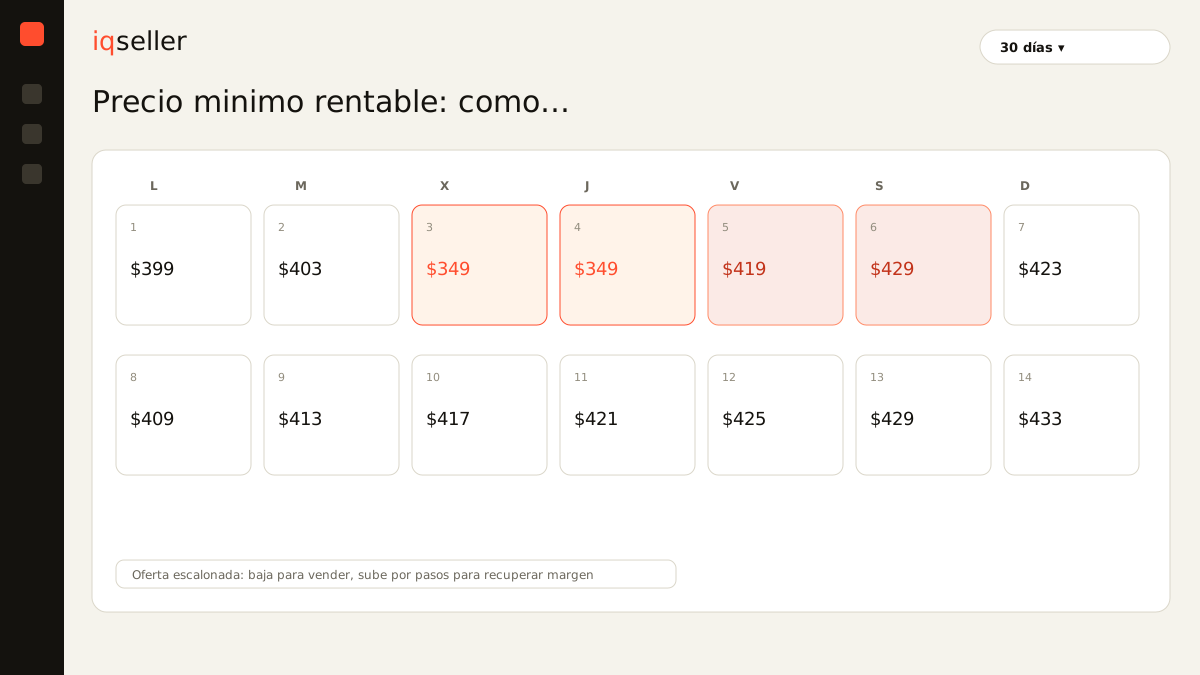
The minimum profitable price isn’t just for not losing. It’s for designing your strategy with confidence. Once you know your floor per channel, you have the full range: you know how far you can drop in a laddered offer without bleeding, and how far to raise it afterward to recover margin.
With the floor clear, an aggressive promotion stops being a gamble and becomes a calculated play: you drop until you’re brushing the floor during the demand peak, gain traction and ranking, and ladder back up as sales momentum allows. The floor is the safety net that lets you play high without fear.
Dictionary: laddered offer, step by step →the link to inventory and the operation
A selling floor doesn’t live in isolation. It connects to your real-time inventory and to the health of your whole operation. If a product turns slowly, its prorated fixed costs per unit rise —warehouse occupied longer, capital tied up— and its real floor is higher than a static calculation suggests. A product that flies spreads those fixed costs across more units and can bear a lower floor.
That’s why the right number doesn’t come from a frozen formula, but from data that moves with your business: how many units you move, how long they’ve sat in the warehouse, which fees you were charged this week. The seller who treats their minimum profitable price as living data —not as a spreadsheet cell they updated in March— is the one who knows, on every pricing decision, whether they’re building margin or giving it away.