
Individual vs Professional Amazon Plan Compared
July 15, 2026
The difference between Amazon’s Individual and Professional plan comes down to one question: how many units you sell per month. The Individual plan has no fixed monthly fee, but it charges you a fixed per-item fee on every unit you sell. The Professional plan charges a flat monthly subscription in exchange for making that per-item fee disappear. The break-even point is pure arithmetic: once you sell more units than the subscription covers at the per-sale fee rate, Professional becomes cheaper. In Mexico that threshold usually lands somewhere around 40 to 50 sales a month, though the exact number depends on the fees in force.
But boiling the decision down to cost is a mistake, because the Professional plan doesn’t just change how much you pay: it changes what you’re allowed to do. Individual is built for someone who sells occasionally and needs no tooling: no access to business reports, no Amazon Advertising (Sponsored Products), no promotions, no ability to compete for the Buy Box, no bulk catalog uploads. Professional unlocks all of it. So the real comparison isn’t “flat fee versus per-sale fee,” it’s “a casual seller with no tools versus a seller who wants to grow with data and advertising.”
This article takes the comparison apart piece by piece: what each plan charges, which features Professional unlocks, at what volume it’s worth switching, and why —if you sell across several channels— knowing whether the plan pays for itself hinges on a number almost nobody has on hand: the real net margin per unit, cross-referenced across Amazon, MercadoLibre and the rest of your operation.
what each plan charges, no fine print
The Individual plan runs on a “pay when you sell” logic. There’s no subscription: Amazon deducts a fixed fee on every unit sold, on top of the category commission (referral fee) that every seller pays regardless of plan. That per-item fee is what makes Individual expensive the moment your volume climbs: every sale drags that cost, whether you sell one unit or a thousand.
The Professional plan flips the equation. You pay a flat monthly fee —independent of how much you sell— and in exchange Amazon drops the per-item fee. You still pay the category commission; that never changes with any plan, but the per-unit cost falls because the fixed per-sale charge is gone. If you sell a lot, the subscription spreads across many units and the per-unit cost drops toward just the category commission.
The common mistake is comparing only these two numbers and stopping there. The Professional subscription isn’t an expense: it’s the key that unlocks advertising, reports and the Buy Box. And those three things, used well, tend to move more money than the fee difference ever does. So it’s worth seeing the monthly fee not as a cost to avoid, but as the entry ticket to a toolset the Individual plan simply doesn’t have.
the features only Professional unlocks
This is where the comparison stops being about price. The Individual plan is, in practice, an account for selling without infrastructure. You don’t get Amazon Advertising (Sponsored Products), so you can’t advertise inside the marketplace: you depend on buyers finding you organically. You don’t get business reports, so you fly blind on what sells, when and at what margin. You can’t create promotions or coupons, you can’t bulk-upload your catalog (you list product by product), and you don’t compete for the Buy Box.
Glossary: the Buy Box is the featured purchase box where the vast majority of sales land; only Professional-plan sellers who meet certain performance requirements can win it, and without it your product barely sells even when it’s listed.The Professional plan opens all of that. You can run Sponsored Products campaigns —which leads straight to measuring your ACoS, because advertising without reading that number is burning budget—, download sales and traffic reports, build promotions, bulk-upload catalog and, above all, join the fight for the Buy Box. For anyone serious about growing, that list isn’t optional: it’s the minimum floor for operating as a business rather than a garage sale.
the crossover point: when to switch by pure arithmetic
The financial rule is simple. Divide the cost of the Professional monthly subscription by the fixed per-item fee of Individual. The result is how many sales you need per month for both plans to cost the same. Below that number, Individual is cheaper; above it, Professional. In Mexico that threshold, with typical fees, lands somewhere around 40 to 50 units a month, but you should run the math with the fees active on your own account, not a blog figure.
Now, the mistake is treating that crossover as the final answer. If you’re near the threshold or growing, Professional pays off before you hit break-even, because the tools it unlocks —advertising, Buy Box, reports— help you sell more units, which in turn pushes your volume above the crossover. It’s a loop: you pay the subscription, gain tools, sell more, the subscription pays for itself. Staying on Individual “to save money” when you’re already brushing the threshold usually costs more in lost sales than it saves in fees.
The reverse applies too: if you sell five or ten units a month sporadically, paying the Professional subscription to access tools you won’t use is throwing money away. Individual exists precisely for that profile. The right decision depends on where you are and where you’re headed, not on a single rule.
what does NOT change between plans (and why it matters)
A frequent misunderstanding is believing the Individual plan “comes cheap” because it pays lower commissions. False. The category commission (referral fee) —that percentage Amazon deducts from your sale price— is identical on both plans. FBA fees are identical too if you use Amazon’s fulfillment: storage, handling and shipping are charged the same whether you’re on Individual or Professional. We dig into how much FBA weighs on your wallet in Is Amazon Storage Expensive for FBA Sellers, and there no plan saves you: you pay it either way.
The only thing that changes with the plan is the seller layer: the fixed per-item fee (present on Individual, gone on Professional) and access to tools. Everything else —category commission, FBA fees, tax, your product cost— is constant. That’s why, when you calculate whether switching plans is worth it, looking at the fee difference isn’t enough: you have to look at the real net margin per unit, which is what’s left after subtracting absolutely everything.
Glossary: real net margin is what’s left per unit after subtracting category commission, plan fee, FBA fees, advertising and taxes from the sale price; it’s the only number that tells you whether a SKU truly wins or loses, and the one that tells you whether the Professional subscription pays for itself.the multichannel angle: how to know if the plan pays for itself
Here’s the real pain for the seller who sells in more than one place. To know whether the Professional plan pays for itself, counting units isn’t enough: you need to know how much net margin each one leaves, and that number lives scattered. The commission and fee come from Amazon’s report, the product cost lives in your accounting, the ad spend is in the Advertising console, tax you calculate separately, and if the same product also sells on MercadoLibre or Shopify, you have to open yet another dashboard to compare where it leaves more profit.
The result is the usual ritual: download reports, cross them in Excel once a month, and decide with a number that’s already expired. By the time you assemble the sheet that says “Professional is worth it because I sold 60 units and the ads paid off,” weeks of blind decisions have already passed. And the underlying question —is the subscription being paid for by the extra sales the Buy Box and advertising brought in?— goes unanswered, because nobody has the consolidated margin, per SKU, up to date and comparable across channels.
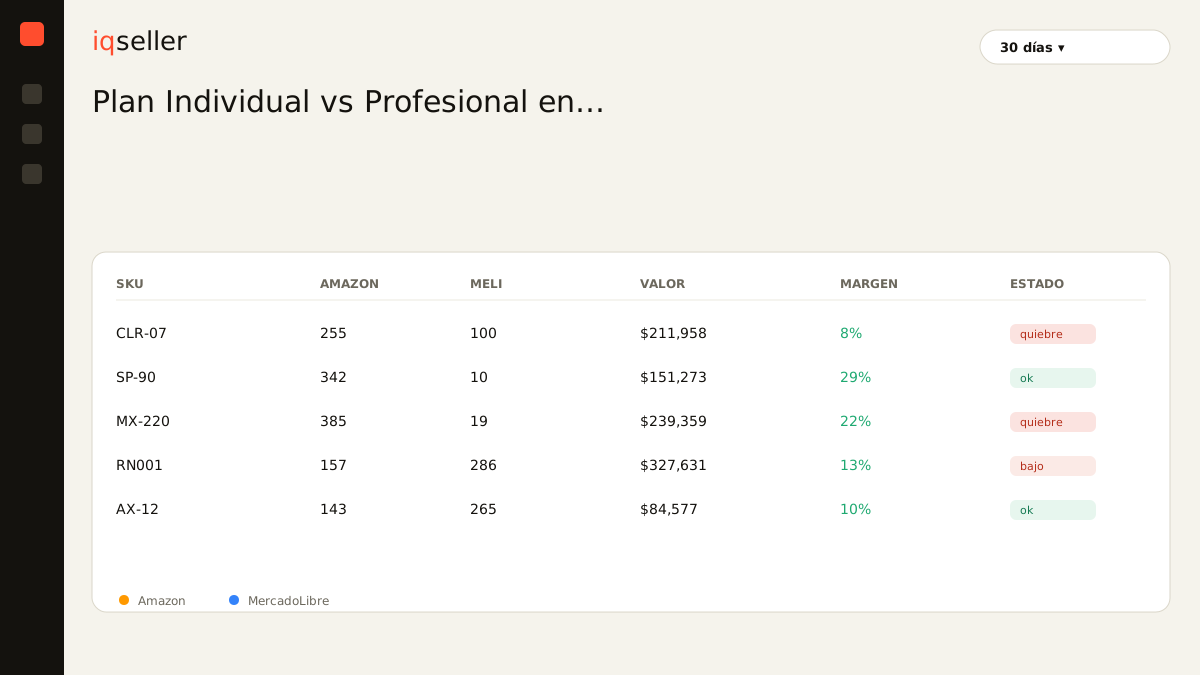
Glossary: a unified catalog joins the same real product —even when it has separate listings on Amazon and MercadoLibre— into a single record, so you can compare margin per SKU across channels and answer whether a plan pays for itself without cross-referencing reports by hand.That’s where real time changes the game. When the plan fees, category commission, FBA fees, ad spend and product cost flow in automatically, mapped to each SKU and consolidated across Amazon and MercadoLibre in a single dashboard, the question “is Professional worth it?” stops being a month-end calculation and becomes a reading. You see, today, how many units you sold, what each plan actually cost you and whether the subscription has already paid for itself in margin. The plan decision goes from an annual bet to a live number you confirm every week.
how to decide your plan, step by step
You don’t need to rebuild your accounting to choose well. Start by counting your units sold over the last real month on Amazon. If it’s clearly under 40, and you sell sporadically with no intent to advertise, Individual is your plan, full stop. If it’s clearly over 50, or if you already want to run Sponsored Products and fight for the Buy Box, Professional justifies itself on tools alone, before you even run the fee math.
If you’re in the gray zone —between 30 and 60 units, or growing month over month— run the fine math: divide the monthly subscription by the per-item fee to find your exact crossover with the fees in force, then ask yourself whether Professional’s tools would help you clear that threshold. Almost always, for a growing seller, the answer is yes, because advertising and the Buy Box are exactly what pushes volume upward.
And whatever your plan, close the exercise by calculating the real net margin of your five highest-volume SKUs, subtracting everything: commission, plan fee, FBA, advertising, tax and product cost. That number tells you not only which plan suits you, but which products are worth pushing and which you’re selling at almost no profit. The plan choice is only the first decision; real margin is the one that governs all the rest.