
Margin Calculation Mistakes That Cost Sellers Money
August 16, 2026
The mistake that costs sellers the most money when calculating margin is confusing gross margin with net margin: subtracting only the product cost from the sale price and calling that “profit.” That number looks healthy, but it is not what reaches your pocket. Real net margin is what is left after marketplace commissions, fulfillment fees, storage, inbound shipping, returns, advertising, and tax. Between the price you see and the profit you actually collect there is a line of deductions that, added up, eat the difference, and most sellers do not see it until the statement fails to reconcile.
The second mistake, quieter, is calculating that margin once, at launch, and never touching it again. FBA fees go up, a category commission changes, returns spike in high season, a competitor forces you to drop the price. The margin you calculated in January no longer exists in August, but your spreadsheet still shows the same nice number. You keep selling with the peace of mind of a profit that has already evaporated.
This article walks through the concrete mistakes that make a multichannel seller believe they are making money when they are actually subsidizing every sale. Most of them are not math errors: they are errors of incomplete data, forgotten line items, and calculations that fall behind platforms that change every week.
confusing gross margin with net margin
This is the parent mistake that almost all the others come from. Price minus product cost is gross margin, and it means almost nothing on its own. The number that decides whether the business lives or dies is net margin: what is left once you have subtracted absolutely everything the sale cost you.
The trap is that gross margin always looks generous. A product you buy for $180 and sell for $499 “has” a 64% gross margin. Sounds like a clean deal. But once you subtract the referral commission, the fulfillment fee, prorated storage, the returns provision, and the slice of advertising, that 64% easily turns into 11% or 12%. And if you also forgot the tax, the real figure can be negative. A seller setting prices by looking at gross margin is making decisions with the wrong number.
Glossary: real net margin, with everything subtracted →forgetting tax in the calculation
Tax is the line item most people leave out, and not because of a minor oversight: because they are not clear on how it works inside the price. In Mexico that 16% VAT is not yours, even though it lands in your account. If you treat the sale price as if it were all revenue, you are inflating your margin by exactly the proportion of the tax you later have to remit.
The fine detail is that tax does not only show up on your sale: you also pay it on your product cost, on marketplace fees, and on advertising. Handling it badly, or not at all, means your margin calculation is skewed on both sides. A product can look profitable with tax “baked in” and stop being profitable once you correctly pull it out of the equation. This is one of the mistakes that separate the margin you think you have from the one you actually collect.
ignoring hidden marketplace commissions and fees
This is where selling across several channels at once turns treacherous. Amazon’s referral commission is not the same as MercadoLibre’s, and within each platform it changes by category. The fulfillment fee depends on weight and dimensions. There are costs that do not even appear as an obvious line: shipping your inventory into the fulfillment center (inbound), storage prorated per unit, long-term storage when a product stalls, relabeling fees, or charges per unsold unit.
The multichannel seller ends up with a “flat” price everywhere because that is the easiest thing to manage by hand. And there is the expensive problem: the same price can leave you 26% on one channel and 11% on the other, because the fee structure is different. Setting a price without starting from net margin per channel guarantees that on at least one of them you are giving away profit without noticing. This connects directly to what we discussed in what is ACoS: advertising is another fee that comes out of that same margin, and if you do not subtract it, your profitability is fiction.
not provisioning for returns and refunds
Returns are not an annoying exception: they are a structural cost of the channel, and calculating margin as if they did not exist is fooling yourself. When a product is returned, you do not just lose the sale; often you pay the return shipping, the inspection, the reconditioning, and in some cases the unit can no longer be sold as new.
The typical mistake is looking at the margin of a perfect sale and assuming they all are. If your category has an 8% return rate, your real average margin is below the unit margin you calculated, always. The correct way is to provision: subtract an expected return percentage from each product based on its history. A seller who moves apparel or electronics and does not do this lives with an inflated margin that reality corrects every month-end, almost always against them.
calculating once and never looking again
This is the time mistake. Even when the initial calculation is done well, with tax, fees, and returns, it ages. Platforms adjust fees, your supplier raises cost, the exchange rate moves, warehouse occupancy changes the proration, and a price war pushes you down. Margin is a snapshot taken at one moment; treating it as permanent is the most common path to selling at a loss without realizing it.
The average multichannel seller lives this problem multiplied by the number of dashboards they have to piece together by hand. Download the Amazon report, export the MercadoLibre one, cross the costs in a sheet, apply formulas, and by the time they finish, the numbers have already changed on the platform. The calculation is always behind, and pricing decisions get made on stale information. That is why the useful margin is the one you see today, per product and per channel, already with everything subtracted, not the one you rebuild every two weeks by hand. That is where real time stops being a luxury and becomes the difference between reacting and deciding.
setting prices without seeing real margin per channel
The last mistake gathers all the previous ones into a single decision: setting a price. Many sellers set price by looking at the competitor or at gross margin, and adjust by eye. The result is that they discount down to a point they think is healthy and is actually below their total cost. An aggressive promo can make sense if you know your real net margin floor; without that figure, any discount is a blind bet.
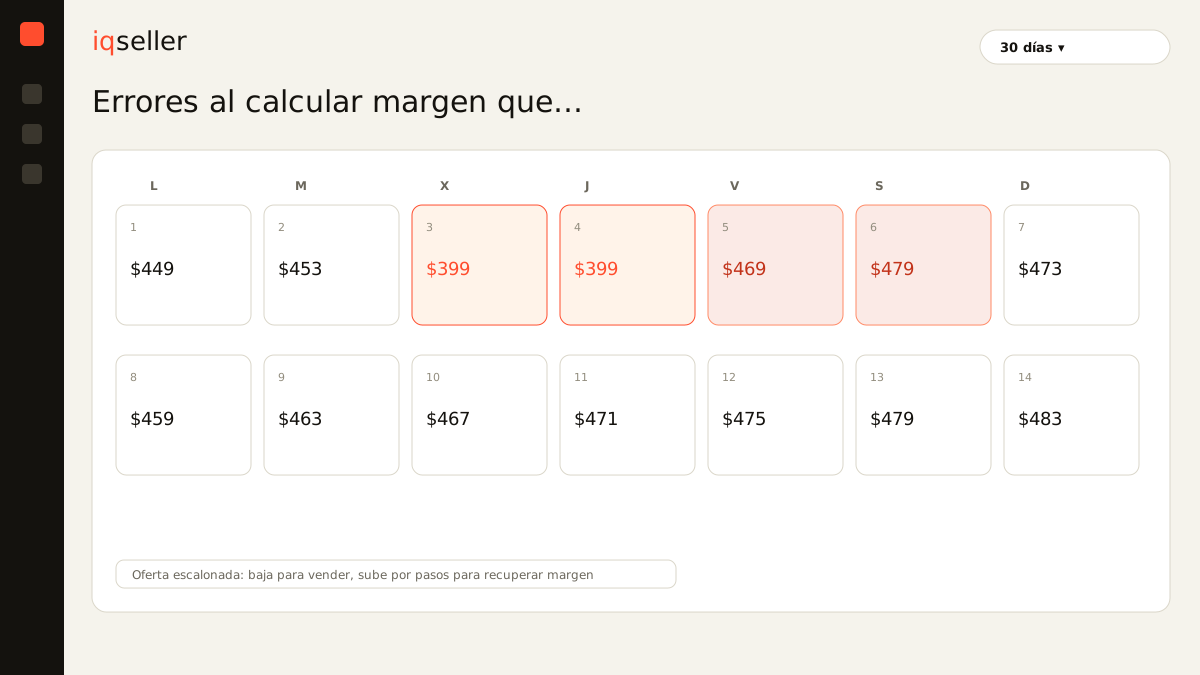
The right move is the reverse: first you know your real net margin per product and per channel, and from there you decide how much you can move the price without hitting a loss. This is exactly what makes possible a pricing strategy that withstands a price war without destroying you, and what lets you schedule a price calendar that drops to gain traction and steps back up to recover profit. Net margin is not a number you check at the end: it is the starting point of every pricing decision.
Glossary: what a price calendar is and why to automate it → Glossary: the laddered offer, step by step →in short
Losing money calculating margin is almost never an arithmetic error: it is subtracting too little. It is confusing gross with net, forgetting the tax, ignoring each marketplace’s hidden fees, not provisioning for returns, and, the most expensive of all, calculating it once and letting it age while the platforms shift underneath you. Each of those gaps inflates the margin you think you have above the one you actually collect.
For the seller running Amazon and MercadoLibre at the same time, with Shopify and 3PL in the mix, the challenge is not the formula: it is having every line item, from every channel, updated at the same moment. Seeing the real net margin per product and per channel, already with commissions, fulfillment, storage, returns, advertising, and tax subtracted, is the difference between growing and growing at a loss. iqseller calculates that margin automatically so your pricing decisions start from the correct number, not the nice one.