
How to get legitimate EAN or GTIN codes for your products in Mexico
July 7, 2026
To get legitimate ean gtin codes for your products in Mexico there is exactly one valid route: buy your codes directly from GS1 Mexico (formerly AMECE), the only authorized body in the country that issues the company prefix your GTINs are built from. With that prefix you generate your own real EAN-13 or UPC-A codes, and they stay registered to your company in the global GS1 database. There is no legitimate shortcut: the “lifetime” codes sold for a few dollars on resale sites are slices of someone else’s prefix, and sooner or later they break your listings.
The most common confusion is thinking EAN and GTIN are different things. GTIN (Global Trade Item Number) is the umbrella name for the number that identifies a product in world trade; EAN-13 and UPC-A are simply formats of the GTIN, one with 13 digits and the other with 12. When Amazon Mexico or MercadoLibre asks you for a “product code,” what they want is a valid GTIN: it doesn’t matter whether you call it EAN or UPC, as long as it’s legitimate and registered to your company.
This article covers where to buy them, what they cost, why resold codes will cause problems, and how to keep that pool of codes organized when you sell across several channels at once without ending up with an impossible spreadsheet and three dashboards open just to know which EAN goes with which SKU.
why only GS1 issues legitimate codes
GS1 is the global organization that has administered the barcode system since the 1970s. It works by country: in Mexico, GS1 Mexico is the office that sells you a company prefix, a unique numeric root assigned to your legal entity. From that root you build each GTIN by adding the product number and the check digit. The key point is traceability: when someone —Amazon, a retailer, a distributor— scans your code and looks it up, the GS1 database must return your company name. That’s the stamp of legitimacy.
Resold codes break exactly that chain. They come from companies that bought large prefixes back in the 2000s and then sliced them up to resell one at a time. GS1 never recognized that practice, so when you look up your “legitimate code,” an unknown company in another country appears, or nothing at all. For a product you’ll only sell in your own store it may not matter today, but on marketplaces it matters a lot.
Dictionary: what an EAN/GTIN is and what it’s for →what it costs and how to buy from GS1 Mexico
The process with GS1 Mexico is straightforward: you go to their site, pick a package of codes based on how many products you handle, pay an initial membership fee and an annual maintenance fee. Packages range from a handful of GTINs for small catalogs to thousands for large brands. That annual fee is what bothers many sellers, because resold codes look like a “one-time payment”; but that annual fee is exactly what keeps your prefix active and verifiable in the global database, which is the entire value of the system.
A practical detail for Mexico: GS1 requires your company’s tax data —RFC, legal name— to assign the prefix. If you sell as a persona física with business activity you can also join. Have your constancia de situación fiscal ready before you start; it speeds up enrollment and prevents the prefix from ending up under the wrong name, something very expensive to fix later.
Once you have your prefix, generating each GTIN is free and you do it yourself. You don’t need to buy a code per product: you buy the prefix, and with it you build as many GTINs as your package allows. That’s where the real work of the multichannel seller begins, which is not getting the codes but managing them.
why resold codes will break your listing
Amazon tightened its GTIN verification years ago. Today, when you publish a new product, Amazon queries the GS1 database directly to confirm that the code’s prefix corresponds to your brand registered in Brand Registry. If your code comes from someone else’s prefix —the case with all resold codes— validation fails and the listing is rejected with errors like “the GTIN does not match the brand” or “invalid code.” It’s not a bug: it’s verification working.
MercadoLibre is more permissive at publish time, but the problem shows up later: duplicate catalogs, products that stick to the wrong catalog because another seller used the same resold code, and content disputes that are hard to win. A code you unknowingly share with twenty other sellers isn’t an identifier, it’s a source of conflict.
The real cost isn’t the one-off rejection, it’s the time. You discover the problem listing by listing, fix it by hand, retry, and each channel gives you a different error message. If this sounds like the afternoons that vanish checking why a given SKU works on one channel but not another, that’s exactly the pain. That’s why it pays to start right: with real GS1 GTINs from the first product. If you already carry codes that fail, review the guide on EAN and GTIN errors that block your listings and how to fix them before publishing again.
the special case: when you CAN publish without a GTIN
Not every product needs its own code. There are two common situations in Mexico. First: if you resell a branded product that already exists in the catalog (say a SPORTIFY item or any well-known brand), you don’t invent a new GTIN; you use the one the manufacturer already registered and attach to that listing. Second: if you make handmade products or a very small private label, Amazon offers the GTIN exemption by requesting it with your brand approved in Brand Registry, and MercadoLibre lets you publish without a code in several categories.
The expensive confusion is mixing the two worlds: wanting your own GTIN for a product that already has the manufacturer’s (you create a duplicate), or trying to publish your own brand with a resold code “to get by” (it gets rejected). The simple rule: someone else’s branded product that already exists → use its GTIN; your new product → your own GS1 GTIN or a formal exemption.
Dictionary: a unified catalog across channels →managing your GTINs when you sell on several channels
This is where the multichannel seller drowns. You buy the prefix, generate fifty GTINs, and now you have to know which code matches which SKU, on which channel it’s published, and whether the same physical product ended up with the same GTIN on Amazon, MercadoLibre and your Shopify. The typical mess is a giant spreadsheet with code columns, another file with internal SKUs, and the vague memory that “I think I already published that one on Meli.” When a GTIN is repeated by mistake or gets crossed, a catalog problem appears that you discover weeks later.
The fix isn’t a tidier file, it’s having the code tied to the product in a single place all channels share. A unified catalog stores each SKU with its GTIN once, and publishes from there to each marketplace with the same identifier. That way the same physical product is the same product across all three channels, and when something changes —a mistyped code, a duplicate— you see it on a board instead of discovering it when the listing has already been rejected.
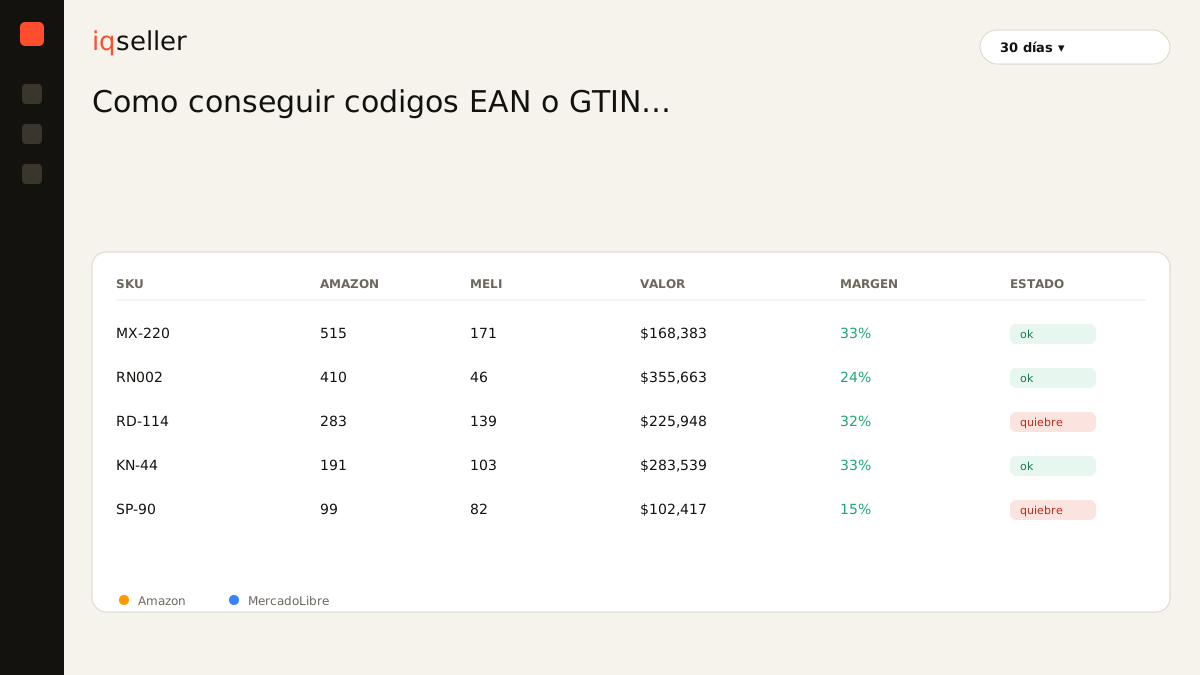
That same unified panel is what lets you cross your catalog against what you actually have to sell. Knowing which SKU has a valid GTIN and real available stock is what keeps you from publishing in real time something you can’t fulfill, or leaving unpublished something you could. And once the catalog is clean, moving prices across channels with an automatic price calendar stops being a puzzle: you already know each price points to a real, identifiable product.
Dictionary: what real available stock is →a checklist so you don’t get it wrong
Before you publish your first product with its own code, verify: one, that you bought the prefix from GS1 Mexico and not from a reseller; two, that your brand is approved in Amazon Brand Registry if you’ll sell there, because without it not even a legitimate GTIN saves you from brand verification; three, that each SKU has a single GTIN and that you don’t use that GTIN on two different products; four, that the same physical product carries the same code on every channel. That last one is what breaks most in practice and costs the most, because it creates duplicate catalogs that no one later wants to untangle.
Doing this right from the start saves you the invisible work that consumes the multichannel seller: the manual reconciliation across channels, the spreadsheet no one trusts, the uncertainty of not knowing whether a product is correctly published on all three sides. Legitimate GS1 codes plus a real-time unified catalog turn that uncertainty into something you see at a glance.