
How Much You Need to Invest to Start Selling on Amazon
August 7, 2026
To start selling on Amazon Mexico you realistically need between $15,000 and $60,000 MXN (roughly USD $800 to $3,300) to launch a single product with some paid traffic behind it. That range isn’t arbitrary: it’s the sum of three blocks —your first inventory order, the Professional plan’s monthly fee (around $600 MXN + tax per month), and the startup costs of registration, branding, photography and your first ad campaigns. The direct answer to “how much to invest to start selling on Amazon” is that the Amazon fee is not what dominates your budget. What dominates is how much stock you buy and how much you set aside for advertising until the product starts turning on its own.
The reason almost everyone underestimates the number is that they look only at the plan price and the product cost, and forget the row of expenses in between: shipping inventory into the FBA warehouse, tax, a returns provision, barcodes, decent photos, and the advertising cushion for the first two or three months. Added up, those “details” usually weigh as much as the merchandise itself. That’s why a realistic budget is built block by block, not in a single stroke.
And there’s one factor almost nobody accounts for when budgeting: the investment doesn’t end when you buy inventory —it starts there. Your cash gets locked up in merchandise and ads for weeks before it comes back as collected sales. Knowing how much capital will sit tied up and for how long matters as much as the upfront amount. This article breaks down each block so you land on your real number.
the Amazon fee: the part that matters least
Let’s start with what everyone asks first, even though it’s the least decisive. Amazon Mexico has two plans: the Individual plan, with no monthly fee but a per-unit charge on every sale, and the Professional plan, with a fixed monthly fee of around $600 MXN plus tax. If you plan to sell more than a few dozen units a month —which is the point where Amazon starts to make sense— the Professional plan almost always comes out cheaper and unlocks reports, advertising and the Buy Box.
So in your annual budget the fee is only ~$7,200 MXN + tax, a fixed and predictable line item. The key thing to understand is that this fee does not include the per-sale referral fees or the fulfillment charges. Every product you sell also pays a referral fee that varies by category, and if you use FBA, a fee to pick, pack and ship each unit. Those fees aren’t upfront investment —they come out of each sale— but they determine your margin and therefore how much capital you need to sustain the operation. Before buying inventory it’s worth reviewing the category referral fees table so you know what percentage you’re playing with.
inventory: the block that dominates the budget
This is where most of your investment lives. The question isn’t “what does one product cost?” but “how many units do I need so I don’t run out of stock before I can restock?”. Amazon rewards continuous availability: if you run out after ten days, you lose ranking, you lose the Buy Box, and you have to start rebuilding history almost from scratch. That’s why a sensible first order is usually between 100 and 300 units, depending on unit cost and your restock lead time.
Run the math with an example: a product that costs you $120 MXN landed in your warehouse, buying 200 units, is $24,000 MXN in merchandise alone. If the supplier is overseas, add freight and duties, which can tack on 15–30% to the cost. And that money stays frozen from the moment you pay the supplier until Amazon deposits your sales —a cycle that’s easily 30 to 60 days. The classic mistake is spending all your capital on the first order and running out of cash to restock right when the product starts selling well. The practical rule: don’t invest more in inventory than you can restock once without decapitalizing yourself.
Glossary: real net margin is what’s left after ALL costs —product, fees, fulfillment, shipping, tax and advertising—, not just price minus cost. It’s the number that tells you how much of your inventory comes back as profit.the startup costs almost everyone forgets
Between the fee and the inventory there’s a list of startup expenses that, added together, usually run $5,000 to $15,000 MXN. They’re not optional if you want to compete seriously:
- Registration and paperwork: an active tax ID, a bank account and, if you’ll import, your importer’s registry. Signing up on Amazon is free, but the paperwork before it has a cost.
- Barcodes (GS1): to create your own listings you need legitimate UPC/EAN codes. Buying fake codes is the fast lane to a suspension.
- Product photography: white background, multiple angles, lifestyle images. Professional photos cost money, but a listing with poor photos converts badly and burns through your ad budget.
- Brand Registry: if you have your own brand, registering the trademark and then enrolling in Amazon Brand Registry gives you A+ content control and protection against listing hijackers. It’s neither cheap nor instant, but it changes your competitive position.
- Samples and testing: ordering samples before buying 200 units avoids the disaster of receiving defective merchandise.
None of these is the star of the budget, but skipping them costs you more later. A listing without good photos or without a registered brand is a listing that spends more on ads to sell the same amount.
advertising: the cushion almost nobody budgets
This is the block that separates a launch that takes off from one that stalls. When you publish a new product, nobody is searching for it yet: no reviews, no history, no ranking. The only way to get those first sales is to pay for visibility with Amazon Ads. And at first your ACoS —the percentage of your sales that goes to advertising— will be high, sometimes 40% or more, because you’re buying traction, not profitability.
That’s why you need to reserve an advertising cushion of at least $5,000 to $15,000 MXN for the first two or three months, knowing a good chunk of it will go into learning which keywords convert. That spend isn’t throwing money away: it’s buying the first reviews and the ranking that later hand you cheaper organic sales. But you have to budget it up front, because if you run out of ad capital just as the listing was starting to lift off, you kill the momentum. Understanding what ACoS is before you launch helps you set how much you can spend per sale without burning your margin. The choice between FBA and FBM also changes your per-unit cost and, with it, how much margin you have left to fund ads; if you haven’t made it yet, see FBA vs FBM: which fulfillment model to choose.
the full budget, block by block
Putting it all together, a realistic launch for a single product on Amazon Mexico looks like this:
| Block | Typical range (MXN) |
|---|---|
| Inventory (100–300 units) | $12,000 – $36,000 |
| Shipping to FBA + duties | $2,000 – $8,000 |
| Professional fee (3 months) | ~$2,100 + tax |
| Registration, barcodes, photos | $3,000 – $10,000 |
| Advertising cushion (2–3 months) | $5,000 – $15,000 |
| Total to get started | ~$24,000 – $77,000 |
The range is wide on purpose: it depends on your category, on whether you import or buy locally, and on how aggressive your launch is. What doesn’t change is the structure: inventory and advertising dominate, the fee is the least of it, and the “small” costs add up to more than they seem. A budget that only accounts for product and fee falls short by design.
Glossary: the Buy Box is the default purchase button on a shared listing; winning it depends on price, availability and performance, and without it your units barely sell even after you’ve invested in inventory.why knowing your real number saves you the capital
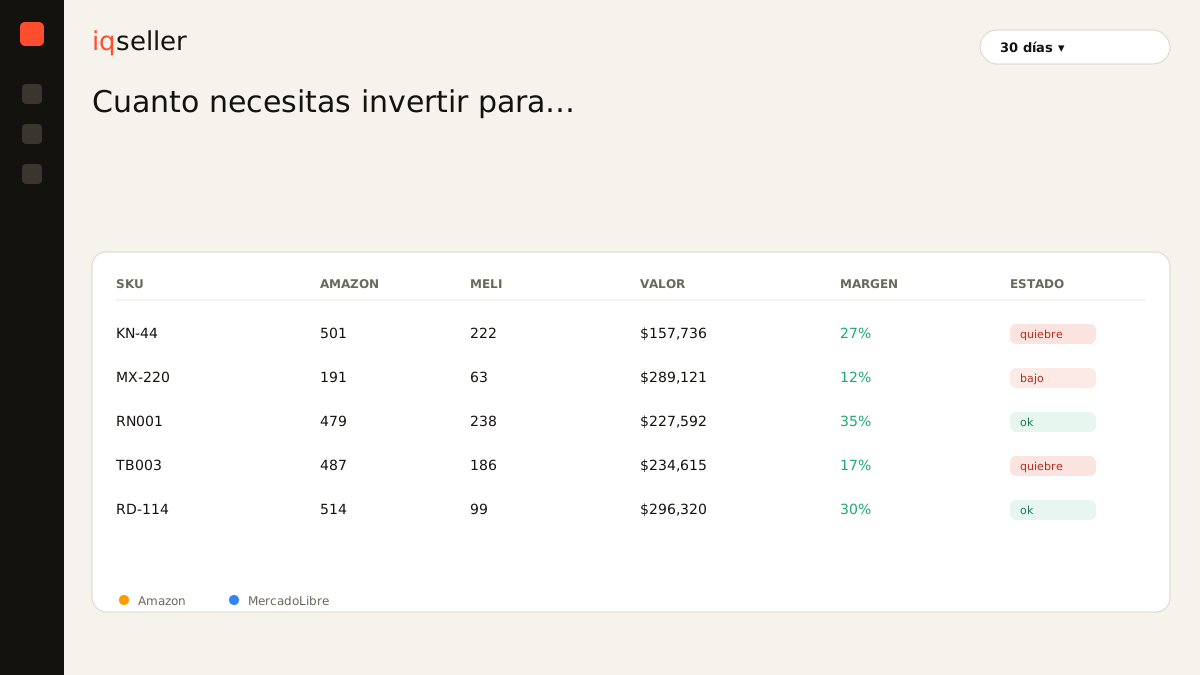
This is where the multichannel seller’s pain shows up even before the first unit sells. To know how much you really need to invest, you have to cross data that lives in different tabs: your supplier cost on one side, Amazon’s referral fees on another, FBA fees in a separate simulator, tax in your accounting, and ad spend in the Ads console. Building that calculation by hand in Excel, every time you evaluate a product, is slow and always goes stale the moment Amazon adjusts a fee.
And the problem multiplies when you sell on more than one channel. The same product has a different fulfillment cost on Amazon than on MercadoLibre, different fees, and therefore a different amount of frozen capital. Without a single view, you end up budgeting each channel separately, by hand, and discover too late that a product that looked profitable on one marketplace barely broke even on the other. Seeing the real net margin per product and per channel, with everything already deducted, turns “how much do I invest?” into a concrete number instead of a hunch. A unified catalog where each SKU carries its cost, its fees and its ad spend is the difference between budgeting with data and budgeting on hope.
Glossary: the unified catalog brings all your SKUs from every channel into a single view, with cost, fees and availability; it’s the basis for calculating how much capital each product demands without cross-referencing tabs by hand.Starting to sell on Amazon isn’t expensive because of the fee; it’s demanding because of the capital you freeze in inventory and advertising before you see the first deposit. Budget by blocks, leave a cushion to restock and to advertise, and above all calculate your real margin per product before you buy the first unit. That number —not the monthly fee— is what decides whether your investment comes back as profit or stays trapped in a warehouse.