
Gross Margin vs Net Margin: What Actually Sets Them Apart
July 9, 2026
The core difference is simple: gross margin is what’s left of the selling price after you subtract only the cost of the product, while net margin is what’s left after you subtract everything else — marketplace commissions, fulfillment fees, shipping, advertising, tax and operating costs. Gross margin tells you whether a product makes sense in theory. Net margin tells you whether you actually made money. A product can show a brilliant 50% gross margin and land at a net margin of barely 6% once Amazon or MercadoLibre take their cut.
That gap between “looks good” and “left a profit” is where most multichannel sellers get lost. You look at your costing sheet, see that you buy at $200 and sell at $400, and celebrate a 50% margin. But between those two numbers live the category commission, the FBA fee or 3PL shipping, the ad spend that brought the sale, and the tax you have to remit. Subtract all of that and the 50% shrinks to single digits — sometimes less than that. There are SKUs that sell a lot and lose money on every unit, and you don’t find out until the month closes.
This article separates the two concepts precisely, explains which cost goes into each, why they get confused so often, and which one to use depending on the decision you’re making. Because using the wrong margin isn’t a minor accounting slip — it’s the reason a “profitable” product quietly decapitalizes you month after month.
what gross margin is and which costs it includes
Gross margin is selling price minus cost of goods sold (COGS), expressed as a percentage of price. If you buy a product at $200 and sell it at $400, your gross profit is $200 and your gross margin is 50%. COGS covers what it cost you to acquire or manufacture the product: the supplier price, prorated import freight, duties where they apply, and sometimes packaging. Nothing else.
Gross margin is a useful and necessary metric: it tells you whether the product has room to absorb all the costs that come after. A product with a 12% gross margin simply has no cushion to pay a 15% commission plus fulfillment plus advertising; it’s born in the red. That’s why gross margin works as the first filter for what’s worth listing at all. But treating it as your real profit is the classic mistake that decapitalizes entire operations. Gross margin is the ceiling of what you could earn, not what you earn.
what net margin is and why it’s the number that matters
Net margin starts from the same selling price, but subtracts absolutely everything that stands between that sale and the money that actually lands in your account. In a multichannel context that means: marketplace commission (which varies by category and channel), the fulfillment fee — FBA on Amazon, Full or Flex on MercadoLibre, or your 3PL fee — the cost of the advertising that pushed the sale, payment processing fees, shipping to the customer when you absorb it, and tax. On top of that result you still have to prorate fixed costs: storage, staff, software.
That final number — what genuinely stays with you per dollar sold — is your net margin, and it’s the only one that answers the question that matters: does this product make me money? Everything else is an intermediate step. You can read more on how to isolate each component in what is net margin on Amazon and how to calculate it per product, which breaks the calculation down SKU by SKU. The logic is the same on any channel: only the percentages change.
Glossary: real net margin is what remains after ALL costs — product, fees, shipping, tax and advertising — not just price minus cost.why they get confused so often (and who benefits from the confusion)
The confusion isn’t accidental. Marketplace dashboards tend to show you gross sales figures and, at best, a commission, but they rarely consolidate fulfillment, advertising and tax into a single per-product margin. The picture you see is optimistic by design: it shows revenue, not what’s left over. So mentally you equate “I sold a lot” with “I earned a lot” — and those are different things.
On top of that, gross margin is easy to calculate — two numbers you already know — while net margin requires pulling data scattered across five places. It’s human to settle for the easy math. But that’s the trap: the cost that bites your profit hardest — advertising, variable fees — is exactly the one that doesn’t show up in the quick calculation. If you want to understand how much advertising eats out of that margin, what is ACoS explains why a “healthy” ACoS can still leave you at a loss once you subtract it from net margin.
a worked example: the same SKU on two channels
Take a product you buy at $200 and sell at $499. Your gross margin is 60% — it looks splendid. Now ground it.
On Amazon with FBA: a 15% category commission ($75), an FBA fee ($55), advertising prorated at a 12% ACoS ($60), processing included, and tax that adjusts net revenue. After all that, your net profit is around $80 — a net margin of roughly 16%. On MercadoLibre with Full at the same price: a commission that can reach 16-18% plus a shipping cost the program deducts by price bracket, and Product Ads advertising with its own logic. Net margin can land at 11% or even less. Same product, same price, net margins that differ by five or six points depending on the channel.
That detail is invisible if you look at a single dashboard or average everything into a spreadsheet at month-end. And it drives big decisions: which channel to push volume on, where to raise price, which SKU to pause. MercadoLibre fees 2026 shift the math enough that a product can be your champion on one channel and your dead weight on another.
which one to use for which decision
It’s not about picking one and discarding the other; each margin serves a different decision. Gross margin is your entry filter: when you evaluate a new product or supplier, it quickly tells you whether there’s enough cushion to even try. If gross margin doesn’t cover your typical variable channel costs, don’t bother.
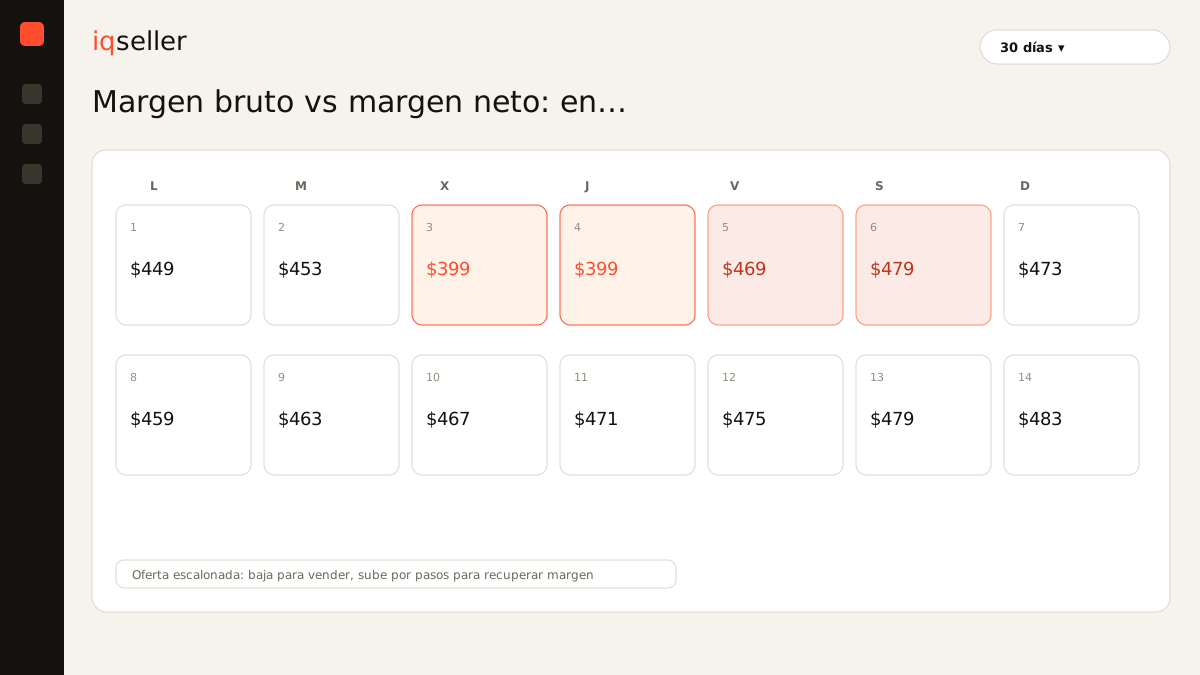
Net margin is your governance tool: to set prices, decide how much to invest in advertising, choose which channel to scale and which SKUs to pause, it’s the only valid number. Setting price off gross margin is the most common way to erode profit without noticing — you drop the price “because you have a 50% margin” and don’t see that your net was already at 8%. This is where a business rule helps: instead of moving prices by hand, a pricing calendar lets you schedule changes by season or event, and a tiered offer adjusts the discount by volume without letting net margin slip into the red at any tier.
Glossary: the pricing calendar lets you schedule price changes by date, season or event without touching each listing by hand. Glossary: a tiered offer applies discounts by quantity bracket while keeping net margin positive at every level.why real time changes the game
The practical problem isn’t understanding the difference between gross and net — it’s keeping it alive. Commissions change, fulfillment fees rise, your supplier cost moves with the exchange rate, and your ad spend varies day to day. A net margin calculated once a month in a spreadsheet is born stale: by the time you finish it, the bids kept running and the supplier raised the price. You’re deciding off a snapshot of yesterday about an operation that changed today.
That’s where pulling everything into a single source of truth stops being convenience and becomes profitability. When net margin per SKU and per channel recalculates itself — pulling current commissions, real fulfillment, the day’s advertising and tax — you stop chasing numbers by hand and start seeing, at a glance, which products actually make money and which only move volume. In iqseller that logic lives next to your sales and inventory, so the gap between gross and net margin is something you see, not something you discover too late. Gross margin tells you what’s possible. Net margin, kept current, tells you what’s real.