
ACoS stands for what: the acronym explained and where the term comes from
July 16, 2026
ACoS stands for Advertising Cost of Sales. It is an advertising metric that expresses, as a percentage, how much you spent on ads relative to the sales those ads generated. If you sold $10,000 thanks to your campaigns and paid $2,000 in clicks to do it, your ACoS is 20%. That’s the short answer to “what does ACoS stand for”: three English words that describe a relationship between spend and sales.
The most common confusion is reading “cost” as if it measured your business costs. It doesn’t. The “C” in Cost refers to the cost of the advertising, not the cost of your product, your fees, or your fulfillment. That’s why the name is so precise: Advertising Cost, the cost of the ad, not the cost of the business. Understanding where each letter comes from saves you the mistake of treating ACoS as if it told you whether you’re making money, when really it only tells you how expensive it was to buy each dollar of advertised sales.
In this article we take the term apart word by word, tell you where it came from, why Amazon popularized it, how to spell it correctly, and how it relates to its cousins — TACoS and ROAS. The goal is that the next time someone asks you “what does ACoS mean?” you have the full answer, not just the formula.
what each word in the acronym means
It’s worth splitting the term into its three pieces, because each carries a meaning that gets lost when you read it as a block.
Advertising is the investment: the money you put into paid ads, bids, and clicks over a period. It’s the numerator of the formula, the money that leaves your pocket and goes to the platform.
Cost is cost, but a specific one: the cost of that advertising. It’s not the cost of your goods or of running the business. This is where almost every seller slips, because the word “cost” evokes profitability and ACoS doesn’t measure profitability. It measures spend efficiency.
of Sales means “relative to sales”: the denominator. And not just any sale, but the sales attributed to those ads within the platform’s attribution window. Organic sales, repeat purchases, and sales that came through your brand don’t count here. Put the three pieces together and the formula is transparent: ACoS = ad spend ÷ ad-attributed sales, as a percentage.
Glossary: ACoS is ad spend divided by the sales attributed to those ads; a low ACoS does not guarantee profit.where the term comes from and why it’s named this way
ACoS wasn’t born with Amazon, but Amazon made it the de facto standard of e-commerce. The logic of an “advertising cost of sales” comes from direct-response marketing, where ad spend has been measured as a percentage of the revenue it produces for decades. It’s the same conceptual family as cost-per-sale and the advertising-to-sales ratio that agencies used long before Amazon Advertising existed.
What Amazon did was take that idea, give it a short name, and put it at the center of the Sponsored Products dashboard as the headline metric. In doing so it defined a very concrete version: campaign spend over click-attributed sales within a fixed window. Because millions of sellers saw that number every day in the ad console, the term caught on, and today “ACoS” is understood in any marketplace advertising conversation, even outside Amazon.
That’s why the term is named so literally: it describes exactly what it does. There’s no hidden metaphor. Advertising Cost of Sales is, word for word, the cost of advertising expressed as a fraction of sales. The precision of the name is also its trap: it sounds like it covers more than it does.
how ACoS is spelled and why that “o” is lowercase
A detail that trips people up: the correct form is ACoS, with a lowercase “o”. It’s not a typographic whim. The acronym takes the initials of the words that carry weight — Advertising, Cost, Sales — and leaves the preposition “of” in lowercase, since it’s a connecting word, not a concept. It’s the same logic by which we write ROAS fully capitalized (all weighty words) but ACoS with that little “o”.
You’ll see variants out there — “ACOS” all caps, “AcoS”, “acos” — and they all refer to the same thing, so don’t get stuck if you run into them. But the convention Amazon uses, and the one you’ll see in serious documentation, is ACoS. Knowing this helps when you’re researching or comparing tools: if a platform spells the acronym carelessly, it sometimes treats the metric carelessly too.
what it actually measures and what it deliberately leaves out
Now that you know what the acronym stands for, it’s worth landing what it measures and what it doesn’t. ACoS measures one thing: the efficiency of your paid spend. It drops when your ads convert well with reasonable bids; it rises when you pay a lot for clicks that convert little. As a “how sharp are my campaigns” thermometer, it’s honest and useful.
What it leaves out is everything that decides whether you make money. It doesn’t include your product cost, the referral fee, the FBA fee, inbound shipping, tax, or returns. ACoS lives entirely on the revenue side and never touches your real costs. That’s why two products with the same 25% ACoS can be in opposite universes — one with a healthy margin, the other losing on every sale — and the percentage looks identical. To know which one you’re in, you need to cross ACoS with your real margin, not just with the formula behind the acronym.
Glossary: real net margin is what’s left after ALL costs — product, fees, shipping, tax, and advertising — not just price minus cost.ACoS, TACoS, and ROAS: the family of acronyms and where each comes from
Once you understand where ACoS comes from, its cousins explain themselves. TACoS is Total ACoS: the same idea, but the denominator is your total sales, not just the ad-attributed ones. The “T” for Total was added precisely to capture the effect ACoS leaves out — how advertising also lifts your organic sales. A TACoS that drops while sales rise is a sign your brand is gaining traction and depending less on paying for each click. If you want to see that difference clearly, we break it down in TACoS vs ACoS.
ROAS — Return on Ad Spend — is the same relationship turned upside down. Where ACoS asks “what fraction of my sale went to ads?”, ROAS asks “how many dollars of sales did I get for each dollar of ad spend?”. They’re mathematical inverses: a 20% ACoS equals a ROAS of 5. That the same data has two acronyms comes from two traditions — marketplaces prefer ACoS, classic digital advertising prefers ROAS. Which one you should look at depends on the question you’re bringing; we cover that in ACoS vs ROAS.
why the term gets complicated when you sell across channels
Understanding what the acronym stands for is simple with a single channel. The moment you sell on Amazon Mexico, MercadoLibre, and maybe Shopify with a 3PL, the term starts meaning slightly different things on each dashboard. Amazon calculates its ACoS with its own attribution window. MercadoLibre reports Product Ads spend with a different logic. Each platform counts attributed sales its own way, so one panel’s “ACoS” isn’t directly comparable to another’s, even though the acronym is identical.
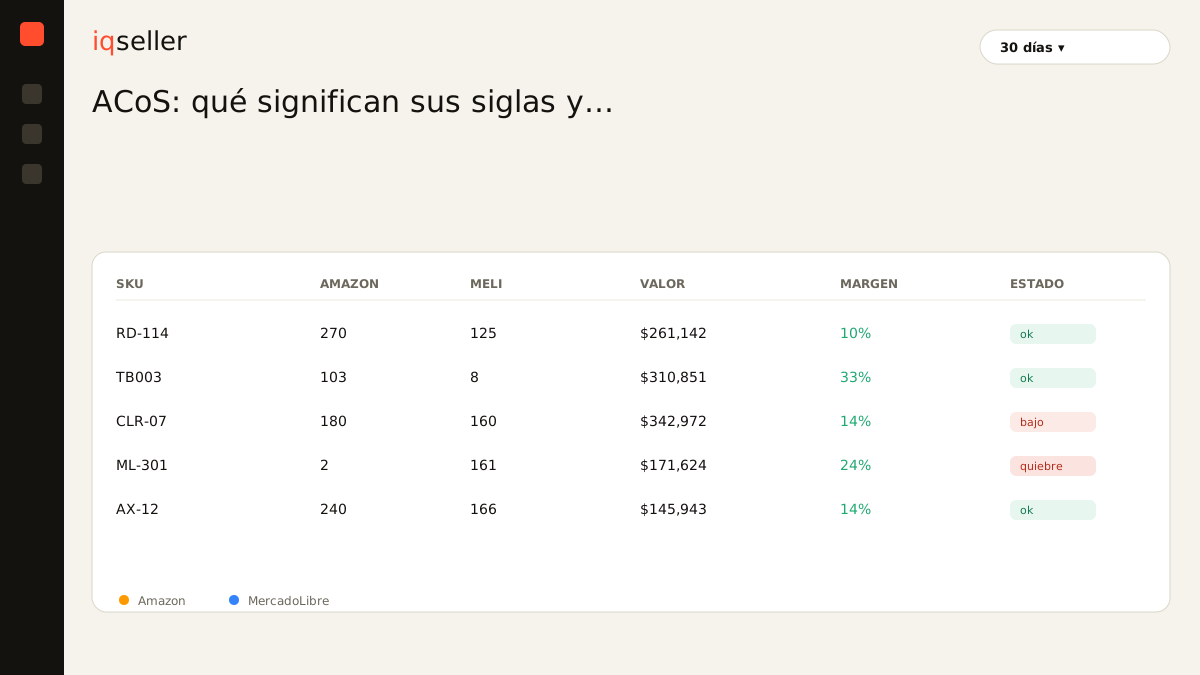
That’s where the pain gets concrete. To compare the same product across channels you end up exporting reports into a spreadsheet, matching SKUs that are named differently on each one, pro-rating costs by hand, and praying the formula has no reference error. And by the time the table is finally built, the data is already from yesterday: bids kept running, stock moved, and you’re deciding on an old snapshot. An ACoS that suddenly climbs isn’t always the campaign’s fault; sometimes it’s conversion that dropped because you ran out of stock on the best-selling color, and your ads keep spending on a listing that no longer converts. When ACoS lives next to your real-time inventory and your margin by channel, the cause jumps out instead of hiding across three tabs.
Glossary: real available stock is sellable inventory net of reservations and transit; if it drops, your conversion falls and your ACoS rises without the campaign changing at all.what to remember
ACoS stands for Advertising Cost of Sales: ad spend as a percentage of the sales those ads generated. Each word matters — Advertising is the investment, Cost is the cost of that investment (not of your business), of Sales is relative to attributed sales. The term comes from direct-response marketing, and Amazon made it the e-commerce standard by putting it at the center of its ad dashboard. It’s spelled with a lowercase “o” because “of” is just a connector.
Knowing what the acronym stands for is the starting point, not the finish line. ACoS measures spend efficiency, not profitability, and it only makes sense next to your real margin and your availability, in real time and with your SKUs unified across Amazon, MercadoLibre, and your 3PL. With that context, the percentage stops being a loose data point and answers the only thing that ever mattered: how much each dollar you invested in ads gave back.